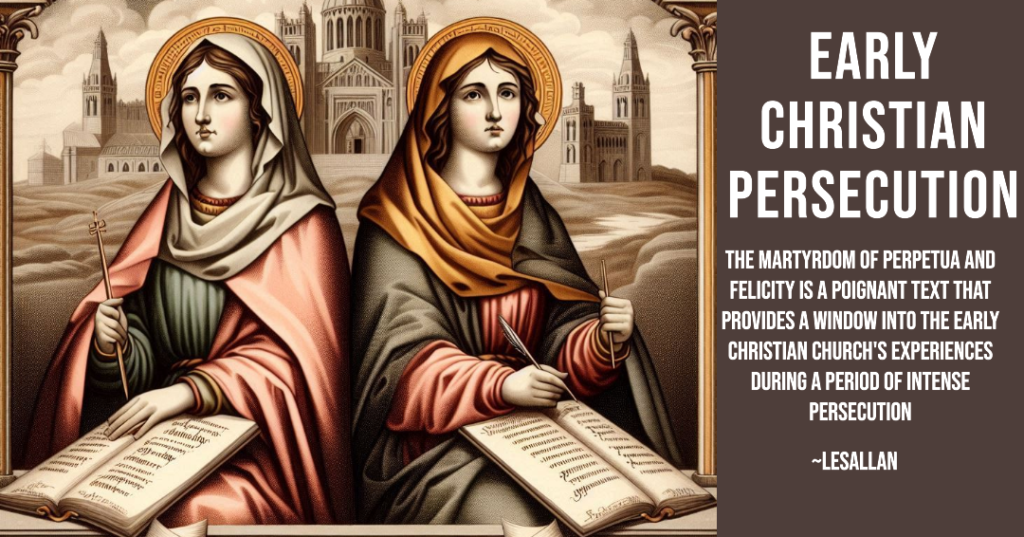
The Martyrdom of Perpetua and Felicity
The Martyrdom of Perpetua and Felicity is a poignant text that provides a window into the early Christian church’s experiences during a period of intense persecution. The document is a historical account and a deeply personal narrative reflecting its subjects’ steadfast faith and spiritual convictions (Christian Electronic Library, 1998; Musurillo, 1972).
The text reveals the church as a community of believers who were deeply committed to their faith, even in the face of death. Perpetua, Felicity, and their companions’ willingness to endure martyrdom rather than renounce their beliefs demonstrates the profound sense of identity and purpose that Christianity provided. The recorded visions and prayers also show the church’s role in providing spiritual support and fostering a sense of unity among believers (Christian Electronic Library, 1998).
The account is set against the backdrop of the great persecution in North Africa during the early third century. This was a time when Christians were subjected to brutal treatment by Roman authorities, often resulting in public executions. The narrative of Perpetua and Felicity, who were martyred in Carthage around 203 AD, illustrates the extreme pressures faced by Christians and the societal tensions between the Roman state and the Christian community (Musurillo, 1972).
The reading is powerful and moving, highlighting the extraordinary courage of these women. What is particularly striking is the clarity and detail with which their experiences and visions are described, offering a unique perspective on their inner lives and spiritual journeys. The text is helpful in understanding the early Christian mindset and the value placed on martyrdom as a witness to faith. However, it can be confusing to modern readers unfamiliar with the historical context or the significance of martyrdom in early Christianity. The blend of personal narrative with visionary experiences may also challenge those accustomed to more straightforward historical accounts.
In summary, the Martyrdom of Perpetua and Felicity serves as a testament to the resilience of the human spirit and the power of faith. It provides valuable insights into the early church’s beliefs, practices, and the historical challenges it faced, while also prompting reflection on the nature of conviction and sacrifice (Christian Electronic Library, 1998; Musurillo, 1972).
References:
Christian Electronic Library. (1998). Ante-Nicene Fathers, Vol. III: The Passion of the Holy Martyrs Perpetua and Felicitas. Www.tertullian.org. https://www.tertullian.org/anf/anf03/anf03-54.htm
Musurillo, H. (1972). The Martyrdom of Saints Perpetua and Felicitas. https://www.ssfp.org/pdf/The_Martyrdom_of_Saints_Perpetua_and_Felicitas.pdf



1 Comment
Bruce Byrd · June 13, 2024 at 7:18 pm
I was recommended this website by my cousin. I am not sure whether this post is written by him as nobody else know such detailed about my trouble. You are amazing! Thanks!
Comments are closed.