August 27, 2024
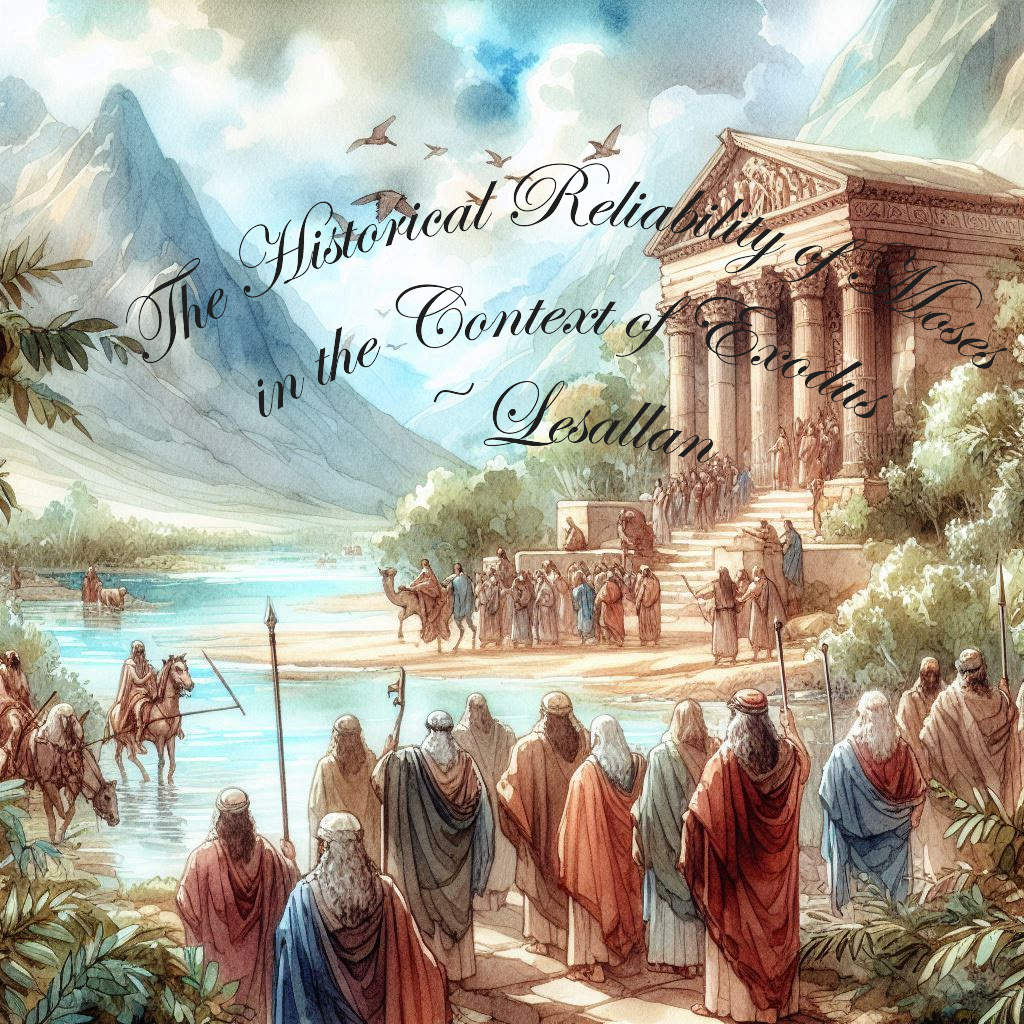
The Historical Reliability of Moses in the Context of Exodus
The historical reliability of Moses has been a subject of debate among scholars, with some arguing that Moses is a fictional character created by biblical writers. However, as we delve into the historical context of the period described in Exodus, it becomes evident that various pieces of evidence support the plausibility of Moses as a real person. Sandra Richter (2008) highlights the unique position of Moses, who, due to his adoption by the Egyptian royal family, received education and training that were uncommon for an Israelite slave. This background equipped Moses with the skills necessary to lead the Israelites out of Egypt and interact with Egyptian royalty (Richter, 2008, p. 173).
David Falk, in his work “The Egyptian Sojourn and the Exodus,” provides additional data that supports Moses’s historical reliability. Falk discusses the presence of Semitic people in Egypt during the New Kingdom period, which aligns with the biblical account of the Israelites’ sojourn in Egypt. He also points out that the name “Moses” is of Egyptian origin, further indicating a historical connection between Moses and Egypt (Falk, 2018).
In his article “Pharaoh” in the IVP Dictionary of the Old Testament: Pentateuch, Brent Strawn emphasizes the significance of the Egyptian context in understanding the story of Moses. Strawn notes that the depiction of Pharaoh in Exodus is consistent with what is known about Egyptian rulers of the time, particularly their absolute authority and the use of forced labor for large construction projects. This historical context supports the plausibility of the events described in Exodus, including the oppression of the Israelites and their eventual escape (Strawn, 2002).
In his article “Moses” in the same dictionary, M.W. Chavalas further elaborates on the historical context of Moses. Chavalas discusses the archaeological evidence supporting a Semitic population in Egypt during the Late Bronze Age. He also highlights the similarities between the biblical account of Moses and other ancient Near Eastern texts, such as the story of Sargon of Akkad, which lends credibility to the historical basis of the Moses narrative (Chavalas, 2002).
The historical context of Moses and Egypt is crucial for understanding the book of Exodus. The narrative is deeply intertwined with the sociopolitical and cultural milieu of ancient Egypt. Understanding the historical context helps to illuminate the significance of the events described in Exodus, such as the plagues, the Passover, and the crossing of the Red Sea. It also provides insight into the challenges faced by the Israelites and Moses’s leadership qualities.
In conclusion, while some scholars argue that Moses is a fictional character, the historical context and evidence presented by Richter, Falk, Strawn, and Chavalas support the plausibility of Moses as a real person. Moses’s unique position, his Egyptian education, and the archaeological evidence of a Semitic presence in Egypt all contribute to the historical reliability of the events described in Exodus. Understanding this context is essential for comprehensively interpreting the book of Exodus and its theological themes.
In Christ,
Lesallan
References:
Chavalas, M. W. (2002). Moses. In T. D. Alexander & D. W. Baker (Eds.), IVP Dictionary of the
Old Testament: Pentateuch (pp. 600-602). IVP Academic.
Falk, D. A. (2018). The Egyptian Sojourn and the Exodus. In J. S. Greer, J. W. Hilber, & J. H.
Walton (Eds.), Behind the Scenes of the Old Testament: Historical, Cultural, and Social Contexts of Ancient Israel (pp. 272–278). Baker Academic.
Richter, S. L. (2008). The Epic of Eden: A Christian Entry into the Old Testament. IVP
Academic.
Strawn, B. A. (2002). Pharaoh. In T. D. Alexander & D. W. Baker (Eds.), IVP Dictionary of the
Old Testament: Pentateuch (pp. 600-602). IVP Academic.