Written By Lesallan | July 27, 2025
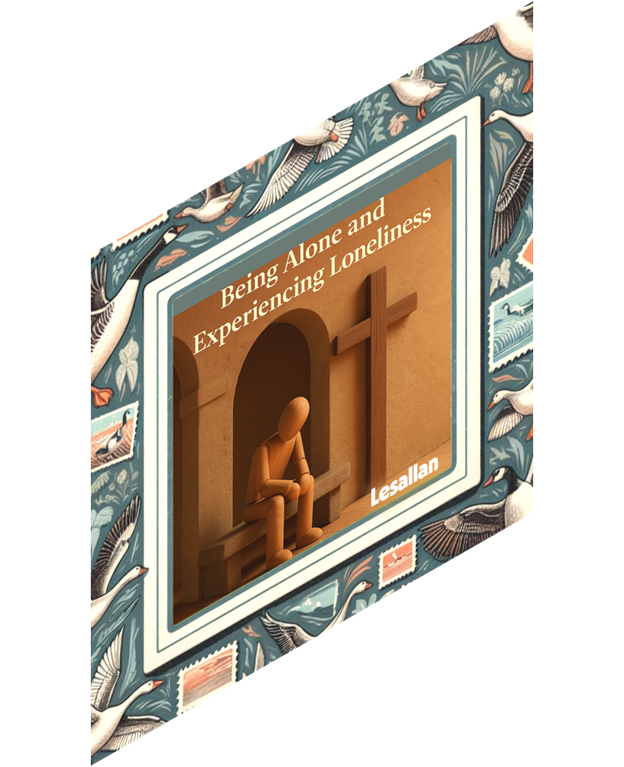
Historical Theology on Being Alone and Experiencing Loneliness
An Exploration of Solitude, Loneliness, and the Divine Through Christian Tradition
Throughout history, solitude and loneliness have prompted deep reflection in Christian theology. Historical theology, with its rich tapestry of voices and traditions, reveals how believers and theologians have grappled with isolation—not merely as psychological states, but as spiritual experiences that can open space for divine encounter and transformation.
In Scripture, we find Jesus seeking solitude to pray (Mark 1:35; Luke 5:16), affirming that purposeful withdrawal can nurture intimacy with God (Holy Bible, King James Version [KJV], n.d.). At the same time, communal worship remains central to discipleship: “For where two or three gather in my name, there am I with them” (Matthew 18:20, KJV).
The Desert Fathers and Mothers of the third and fourth centuries—such as Anthony the Great, Syncletica, and others—embodied solitude as a pathway to sanctification. Their experiences, preserved in The Sayings of the Desert Fathers (Ward, 1984), portray the wilderness not as empty, but overflowing with spiritual challenge and divine presence.
Medieval monasticism was built on this foundation. The Rule of St. Benedict (Benedict, 2001) prescribed silence and withdrawal as disciplines embedded in the community. Meanwhile, mystics like Julian of Norwich and Meister Eckhart viewed solitude as a sacrament. Writing from her cell, Julian described divine revelations that culminated in the assurance: “All shall be well” (Julian of Norwich, 1997). Eckhart (1994) spoke of divine absence as paradoxically revealing God’s nearness.
Importantly, medieval theology distinguished between solitudo electa (chosen solitude) and solitudo invisa (unwanted isolation). The latter, though painful, was seen as a participation in Christ’s abandonment— “My God, my God, why have you forsaken me?” (Matthew 27:46; Psalm 22, KJV).
The Reformation shifted focus to the individual’s conscience before God. Luther’s “tower experience”—a solitary moment of theological awakening—illustrated this inward journey. Calvin similarly wrestled with divine silence yet affirmed the constancy of grace. Devotional classics like The Imitation of Christ (à Kempis, 1955) encouraged believers to cultivate inward solitude for repentance and spiritual growth.
Modernity brought psychological and existential dimensions to loneliness. Kierkegaard diagnosed alienation from self and God as “the sickness unto death” (Kierkegaard, 1980). In the twentieth century, Bonhoeffer, imprisoned yet resolute, distinguished solitude as essential to discipleship from loneliness as social fragmentation (Bonhoeffer, 1959). Tillich’s theology of “the courage to be” addressed loneliness head-on, asserting that existential estrangement ultimately drives us toward the Divine (Tillich, 1952). Rahner (1966) viewed humanity as “the lonely crowd,” yearning for connection amid the mystery of separation.
Biblical narratives reflect this tension. From Adam’s isolation to Elijah’s despair (1 Kings 19) and Jesus’ prayers in Gethsemane, Scripture gives voice to those who are alone before God. The Psalms echo both pain and hope: “Why are you cast down, O my soul?” (Psalm 42:5, KJV), and “Even though I walk through the valley… you are with me” (Psalm 23:4; KJV). Paul’s exhortation to “bear one another’s burdens” (Galatians 6:2) suggests the church’s role in addressing isolation.
Spiritual disciplines have long oscillated between solitude and community. Monastic life strikes a balance between silence and mutual care. Contemporary voices, such as Henri Nouwen and Thomas Merton, reframe solitude as a place of renewal—not escape. “Solitude is the furnace of transformation,” Nouwen writes (Nouwen, 1981). Merton (1958) views silence as a threshold to divine communion and a catalyst for more profound human compassion.
Pastoral theology recognizes loneliness as a universal experience—especially in the context of bereavement, illness, or displacement. Churches respond by cultivating hospitality, companionship, and meaningful liturgy. The Eucharist affirms: “Though we are many, we are one body…” (1 Corinthians 10:17, KJV), offering embodied hope for connection.
Ultimately, historical theology does not erase the complexities of solitude and loneliness. From desert ascetics to modern seekers, Christians continue to discern the difference between fruitful solitude and harmful isolation. Loneliness, though painful, can become a sacred space—a portal to grace where divine presence meets human vulnerability.
As Julian of Norwich’s words echo across the ages: “All shall be well, and all shall be well, and all manner of thing shall be well” (Julian of Norwich, 1997).
Blessings,
Lesallan
References:
à Kempis, T. (1955). The imitation of Christ (L. Sherley-Price, Trans.). Penguin Books. (Original work published 15th century)
Benedict. (2001). The rule of Saint Benedict (T. Fry, Ed.). Liturgical Press.
Bonhoeffer, D. (1959). The cost of discipleship (R. H. Fuller, Trans.). SCM Press.
Eckhart, M. (1994). Meister Eckhart: Selected writings (O. Davies, Trans.). Penguin Classics.
Holy Bible, King James Version. (n.d.). Thomas Nelson.
Julian of Norwich. (1997). Revelations of divine love (E. Spearing, Trans.). Penguin Classics.
Kierkegaard, S. (1980). The sickness unto death (H. V. Hong & E. H. Hong, Trans.). Princeton University Press.
Merton, T. (1958). Thoughts in solitude. Farrar, Straus and Giroux.
Nouwen, H. J. M. (1981). The wounded healer. Image Books.
Rahner, K. (1966). Theological investigations (K.-H. Kruger, Ed., D. Bourke, Trans.). Helicon Press.
Tillich, P. (1952). The courage to be. Yale University Press.
Ward, B. (Ed.). (1984). The sayings of the Desert Fathers: The alphabetical collection. Cistercian Publications.