By Lesallan Bostron
Alumnus of Ohio Christian University
March 13, 2026
Anchored Renewal: How Personal Faith Rebuilds Community Hope
By Lesallan Bostron
Alumnus of Ohio Christian University
March 13, 2026
Abstract
This essay argues that personal spiritual renewal rooted in Scripture catalyzes communal restoration. When individuals undergo inward transformation through spiritual disciplines, that renewal produces public goods—compassionate service, reconciliation, civic participation, and institution‑building—that strengthen social trust and resilience in local communities such as Sheboygan Falls, Wisconsin. Drawing on biblical theology, contemporary Christian commentary, and interdisciplinary scholarship, the paper demonstrates how renewed hearts generate sustainable civic engagement. It concludes by outlining practical pathways for community flourishing through formation, cross‑sector partnership, and patient institution‑building.
Anchored Renewal: How Personal Faith Rebuilds Community Hope
Introduction
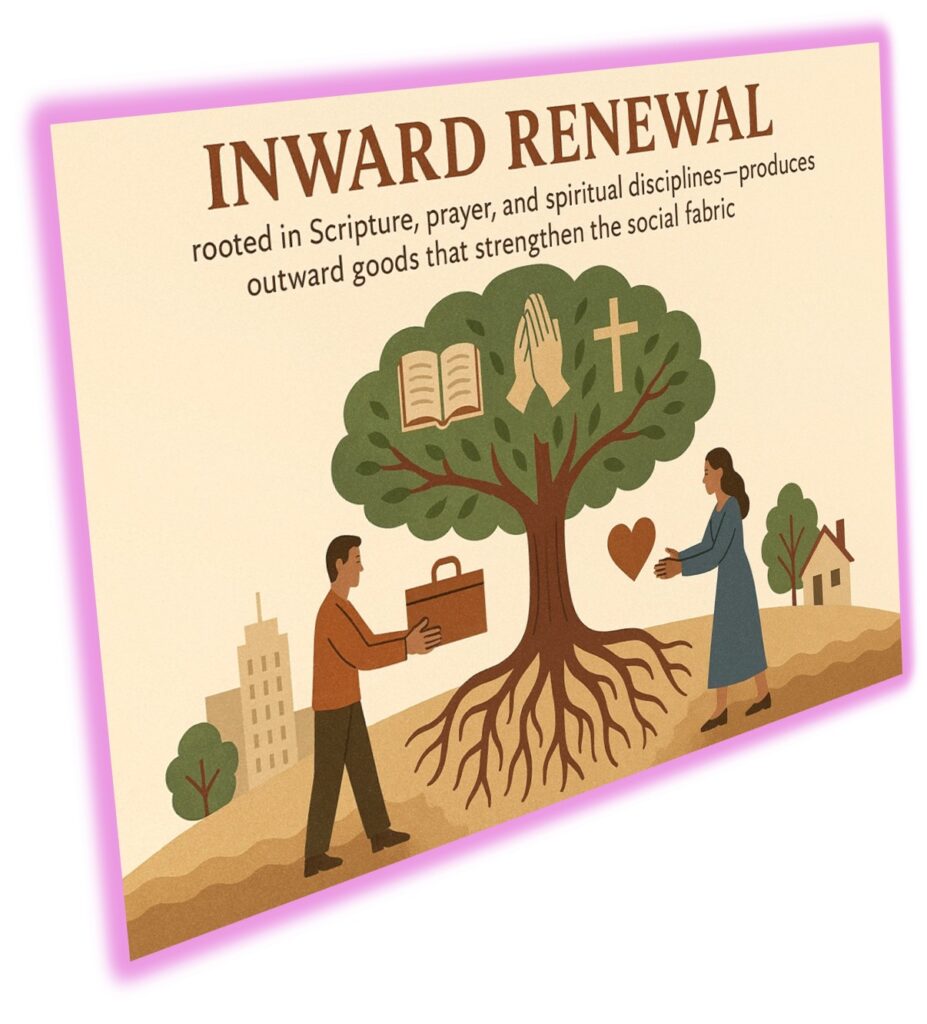
Communities across the United States face rising polarization, institutional distrust, and economic strain. Small towns such as Sheboygan Falls, Wisconsin, experience these pressures acutely as local institutions struggle to maintain cohesion and hope. Yet within Christian tradition, personal spiritual renewal has long been understood as a catalyst for social transformation. This essay argues that inward renewal—rooted in Scripture, prayer, and spiritual disciplines—produces outward goods that strengthen the social fabric. Drawing on biblical foundations, theological reflection, and contemporary social science research, the paper demonstrates that renewed individuals become agents of mercy, reconciliation, and institution-building, thereby restoring communal trust and hope.
Biblical Foundations: Inner Transformation and Outward Fruit
Scripture consistently links inward transformation to outward action. God’s promise— “A new heart also will I give you, and a new spirit will I put within you” (Ezekiel 36:26, King James Bible, 1769/2017)—establishes the theological basis for moral and social renewal. Paul’s exhortation to “be ye transformed by the renewing of your mind” (Romans 12:2, King James Bible, 1769/2017) describes a reorientation of desires and habits that produces concrete acts of neighbor‑love.
Biblical scholars note that this transformation is inherently communal. Wright (2010) argues that the New Testament envisions Christian holiness not as private moralism but as a public witness that embodies God’s restorative purposes in the world. Similarly, Volf (1996) contends that reconciliation is central to Christian identity, requiring believers to enact forgiveness, hospitality, and justice in their communities. Thus, Scripture presents personal renewal as the seedbed of social restoration.
Spiritual Disciplines and Civic Engagement
Empirical research supports the biblical claim that inward renewal produces outward action. Putnam and Campbell (2010) demonstrate that individuals who engage in regular spiritual practices—prayer, Scripture reading, and communal worship—exhibit higher levels of volunteering, charitable giving, and civic participation. These practices cultivate dispositions such as empathy, patience, and generosity, which naturally overflow into public life.
Christian spiritual‑formation literature reinforces this connection. Foster (1998) argues that disciplines such as confession, solitude, and service shape believers into people capable of sustained compassion. Willard (2002) similarly emphasizes that spiritual disciplines train individuals to embody Christlike character in everyday relationships. Thus, spiritual formation is not merely personal; it equips believers for public responsibility.
Mercy and Service: The Good Samaritan as a Civic Model
Jesus’ parable of the Good Samaritan (Luke 10:25–37, King James Bible, 1769/2017) provides a paradigm for mercy that transcends social boundaries. The Samaritan’s compassion is not sentimental but practical—he binds wounds, provides transportation, and ensures long‑term care. When internalized, this ethic generates ministries such as food banks, mentoring programs, and disaster‑relief efforts.
Contemporary congregations increasingly integrate spiritual formation with community resilience. Faith-based toolkits—such as Tearfund’s REVEAL framework and Creation Justice Ministries’ Faithful Resilience resources—combine Bible study with disaster preparedness, mutual aid planning, and environmental stewardship. These initiatives demonstrate how inward renewal becomes outward action, enabling churches to help neighbors prepare for and recover from crises.
Repairing the Social Fabric: Peacemaking and Trust‑Building
Scripture calls believers to be peacemakers: “Blessed are the peacemakers: for they shall be called the children of God” (Matthew 5:9, King James Bible, 1769/2017). Peacemaking restores trust, enabling cooperation across civic institutions. In polarized contexts, this work is essential.
Theological ethicists argue that Christian peacemaking is both relational and structural. Stassen and Gushee (2003) contend that Jesus’ teachings call believers to active nonviolence, conflict mediation, and community reconciliation. These practices rebuild social trust, which sociologists identify as a key predictor of community resilience (Aldrich, 2012).
Writers at TheChristianThing.org (n.d.) emphasize that authentic Christian witness requires both doctrinal clarity and practical charity. Their commentary argues that congregations that integrate formation with service become stabilizing forces in their towns, countering cynicism and strengthening credibility. This dual emphasis prevents hypocrisy and sustains public trust.
Institution‑Building: From Personal Renewal to Structural Resilience
Renewed individuals do more than perform isolated acts of kindness; they build institutions that outlast them. Faith‑motivated projects such as community gardens, renewable‑energy cooperatives, after‑school mentoring programs, and mutual‑aid networks scale personal renewal into structural resilience.
Scholars of community development note that religious congregations are uniquely positioned to build such institutions because they possess social capital, volunteer networks, and physical assets (Cnaan et al., 2016). When congregations marshal these resources, they create durable structures that support long‑term community flourishing.
Case studies on faithful resilience show how churches can leverage land, buildings, and social networks to prepare for climate, economic, and social stresses. In this way, spiritual formation becomes community preparedness.
Historical Precedent and Contemporary Challenges
Historically, faith communities have played central roles in disaster recovery, social services, and community development. From the early church’s care for widows and orphans to modern faith‑based organizations, Christian communities have long demonstrated that inward renewal produces outward good.
Yet contemporary challenges complicate this translation. Polarization, economic strain, and declining institutional trust create barriers to cooperation. Scripture warns against hypocrisy: “Woe unto you, scribes and Pharisees, hypocrites!” (Matthew 23:13, King James Bible, 1769/2017). This warning underscores the need for integrity in public witness. Renewal must be visible in humility, service, and sacrificial love—not merely in rhetoric.
Future Hopes: Formation, Partnership, and Patient Institution‑Building
The path forward is both spiritual and practical. Communities flourish when churches:
- Invest deeply in spiritual formation, cultivating habits of prayer, repentance, and Scripture engagement.
- Build cross‑sector partnerships with nonprofits, schools, local government, and businesses.
- Commit to patient institution‑building, recognizing that durable change requires long‑term faithfulness.
Jeremiah’s promise that God intends an “expected end” of peace (Jeremiah 29:11, King James Bible, 1769/2017) offers a vision for communities like Sheboygan Falls: towns where renewed hearts sustain schools, clinics, mutual‑aid networks, and environmental stewardship. These are the concrete signs that personal faith has become communal hope.
References:
Aldrich, D. P. (2012). Building resilience: Social capital in post-disaster recovery. University of Chicago Press.
Cnaan, R. A., Curtis, D. W., & McGreary, M. (2016). The other Philadelphia story: How local congregations support quality of life in urban America. University of Pennsylvania Press.
Foster, R. (1998). Celebration of discipline: The path to spiritual growth (20th anniversary ed.). HarperCollins.
King James Bible. (2017). King James Version. (Original work published 1769)
Putnam, R. D., & Campbell, D. E. (2010). American grace: How religion divides and unites us. Simon & Schuster.
Stassen, G. H., & Gushee, D. P. (2003). Kingdom ethics: Following Jesus in contemporary context. InterVarsity Press.
The Christian Thing. (n.d.). Articles and commentary on Christian witness and community renewal. https://thechristianthing.org
Volf, M. (1996). Exclusion and embrace: A theological exploration of identity, otherness, and reconciliation. Abingdon Press.
Willard, D. (2002). Renovation of the heart: Putting on the character of Christ. NavPress.
Wright, N. T. (2010). After you believe: Why Christian character matters. HarperOne.