By Lesallan
Sheboygan Falls, WI
Unpublished manuscript chapter
Date: 21 March 2026
Chapter Two — Crossing the Border of the Old Life
Missouri faded behind me long before the state line appeared. The miles were not just distance; they were a shedding. Every hour north felt like peeling away another layer of accusation, disappointment, and the quiet ache of being misunderstood. I did not realize how heavy the air had been until I breathed differently—freer—somewhere between the rolling fields and the first signs for Wisconsin.
Wisconsin greeted me with a kind of cold that felt honest. Not cruel, not punishing—just real. The kind of cold that wakes you up, sharpens your senses, and makes you aware that you are alive. The sky stretched wide and pale, the trees bare and reaching, and something in me recognized the landscape as a mirror. Stripped down. Waiting. Ready for whatever comes next.
As I crossed into my new state, I felt the strange mixture of exhaustion and anticipation that comes when God moves you before you fully understand why. I was leaving behind a place that had become too small for the person I was becoming. Missouri held memories—some sweet, some bitter—but it no longer held my future. Wisconsin, with its quiet rivers and unfamiliar streets, felt like a blank page.
I was experiencing the disorientation of starting over. The way every grocery store aisle feels foreign. The way silence sounds different in a new home. The way you catch yourself reaching for routines that no longer exist. Yet beneath the uncertainty, there was a steady hum of expectation, like the Spirit whispering, “Pay attention. I am doing something new.”
I expected challenges—because new beginnings always come with them. I expected moments of loneliness, moments where I would question whether I had heard God correctly, moments where the weight of rebuilding would feel like too much. But I also expected grace. Provision. Surprises. The kind of blessings that only appear after you have walked through fire and refused to let it consume you.
I expected to meet a version of myself I had not met yet—the one who survived, who endured, who kept walking even when the road was unfamiliar. I expected to find community, purpose, and a deeper sense of calling. And somewhere deep inside, I expected joy to return—not the fragile kind that depends on circumstances, but the rooted kind that grows beside rivers, even in winter.
Wisconsin was not just a new location. It was a promise. A turning of the page. A quiet declaration that the story was not over.
It was only the beginning.
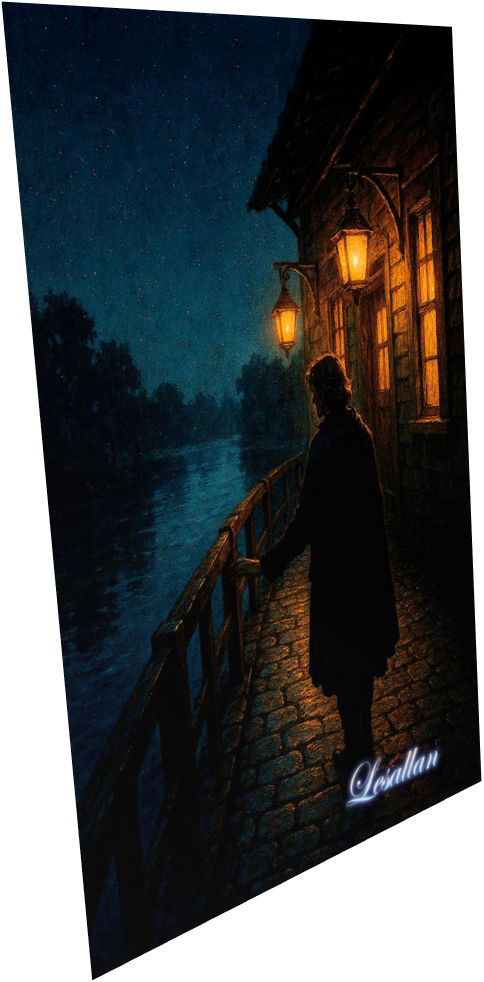
The air tasted of wet wood and river iron; crickets stitched the dark while the inn’s lanterns threw a honeyed smear across the cobblestones. I pressed my palm to the railing and felt the river’s slow pulse beneath—a steady, patient heartbeat that seemed to answer the questions I’d been carrying since the road began.
“Do you ever get tired of asking the same questions?” Mara’s voice came from the doorway, soft as the shawl she’d wrapped around her shoulders.
I laughed, but it was the kind of laugh that folded into a sigh. “Only when I stop listening for the answer.”
She stepped closer; the lantern light caught the wet curl at her temple. “You write about discernment,” she said. “About asking God for wisdom instead of answers.” Her words landed like stones. They echoed the prayers I’d read and written prayers for discernment and reconciliation that keep returning to me.
“Sometimes the answer is a direction,” I said, “and sometimes it’s a quiet that teaches me how to wait.” I could smell coffee from the inn’s kitchen, bitter and warm, and the memory of a hymn hummed under breath—small liturgies that steady a wandering heart.
Mara tilted her head. “Tell me about the road,” she urged.
I told her about the diner with the cracked vinyl booths, the preacher who’d offered a blessing over a stranger’s pie, the night I slept under a sky so full of stars it felt like a promise. I told her about the argument I’d left behind and the way my hands still remembered the shape of the words. As I spoke, the river answered with a soft, constant hush—a reminder that movement and stillness can live together.
At the end, I reached into my pocket and pulled out a folded scrap of paper—lines I’d scribbled from a devotional that morning: “Let the Word master your life.” I read it aloud, not as doctrine but as a map.
Mara closed her eyes. “Then pray,” she said simply. “Not for the map to appear, but for the courage to follow the path you already have.”
We bowed our heads together on the railing, the town’s distant clock marking the hour. My prayer was small and honest: for discernment, for peace, for the stubborn grace to keep walking. When I opened my eyes, the lanterns had not changed, but the world felt less like a question and more like a road with a horizon.
The air tasted of wet wood and river iron; crickets stitched the dark while the inn’s lanterns threw a honeyed smear across the cobblestones. I pressed my palm to the railing and felt the river’s slow pulse beneath—a steady, patient heartbeat that seemed to answer the questions I’d been carrying since the road began.
“Do you ever get tired of asking the same questions?” Mara’s voice came from the doorway, soft as the shawl she’d wrapped around her shoulders.
I laughed, but it folded into a sigh. “Only when I stop listening for the answer.” She stepped closer; the lantern light caught the wet curl at her temple. Her presence felt like a small liturgy—an ordinary thing that steadies a wandering heart. This was the kind of quiet the devotionals call a place for discernment and reconciliation (Lesallan, 2025).
“You write about discernment,” she said. “About asking God for wisdom instead of answers.” Her words landed like stones. I could smell coffee from the inn’s kitchen, bitter and warm, and the memory of a hymn hummed under breath—small rituals that teach patience and attention. The practice of committing decisions to God and waiting for clarity is a recurring counsel in devotional literature on discernment.
“Sometimes the answer is a direction,” I said, “and sometimes it’s a quiet that teaches me how to wait,” I told her about the diner with cracked vinyl booths, the preacher who’d offered a blessing over a stranger’s pie, the night I slept under a sky so full of stars it felt like a promise. As I spoke, the river answered with a soft, constant hush—movement and stillness living together.
At the end, I reached into my pocket and pulled out a folded scrap of paper—lines I’d scribbled from a morning devotional: “Let the Word master your life.” I read it aloud, not as doctrine but as a map (Lesallan, 2025).
Mara closed her eyes. “Then pray,” she said simply. “Not for the map to appear, but for the courage to follow the path you already have.” We bowed our heads together on the railing; my prayer was small and honest: for discernment, for peace, for the stubborn grace to keep walking. When I opened my eyes, the lanterns had not changed, but the world felt less like a question and more like a road with a horizon.
The road had done its quiet work: it had unstitched the old seams and left me with a thinner, truer self—one that could stand in the honest cold and breathe. As the lanterns along the river blinked like small promises, I felt the tug of a future that would not be hurried into being but invited, step by careful step. The ache of what I left behind remained, softened now by perspective and by the steady, patient rhythm of the water. I would still stumble; I would still wonder, but the questions no longer had the same power to define me. In their place rose a steadier thing—an expectant hope, a willingness to be shaped, and the quiet courage to keep walking toward whatever horizon God was making plain one faithful mile at a time.
The road had done its quiet work: it had unstitched the old seams and left me with a thinner, truer self—one that could stand in the honest cold and breathe. As the lanterns along the river blinked like small promises, I felt the tug of a future that would not be hurried into being but invited, step by careful step. The ache of what I left behind remained, softened now by perspective and by the steady, patient rhythm of the water. I would still stumble; I would still wonder, but the questions no longer had the same power to define me. In their place rose a steadier thing—an expectant hope, a willingness to be shaped, and the quiet courage to keep walking toward whatever horizon God was making plain one faithful mile at a time.
Benediction:
May the God who goes before you grant you clear eyes to see the path, steady feet to follow it, and a heart that rests in the promise of new mercies each morning. May discernment guide your choices, grace mend what is broken, and peace keep your soul through every season. Go in the courage of the One who calls you onward; and may the road rise to meet you, the river teach you patience, and the light of Christ lead you home. Amen.
References:
Lesallan. (2025, June 9). A Prayer for Discernment, Reconciliation, and God’s Higher Ways.
TheChristianThing.
Lesallan. (2025, April 22). Devotional: Let the Word Master Your Life. TheChristianThing.
Fellowship Church. (2025, January 16). Daily Devotional: Discernment. Fellowship Church
Devotionals. In Touch Ministries. (2020, January 13). A Need for Spiritual Discernment. In Touch
Ministries.

