Lesallan Bostron
Alumni — Ohio Christian University
November 9, 2026
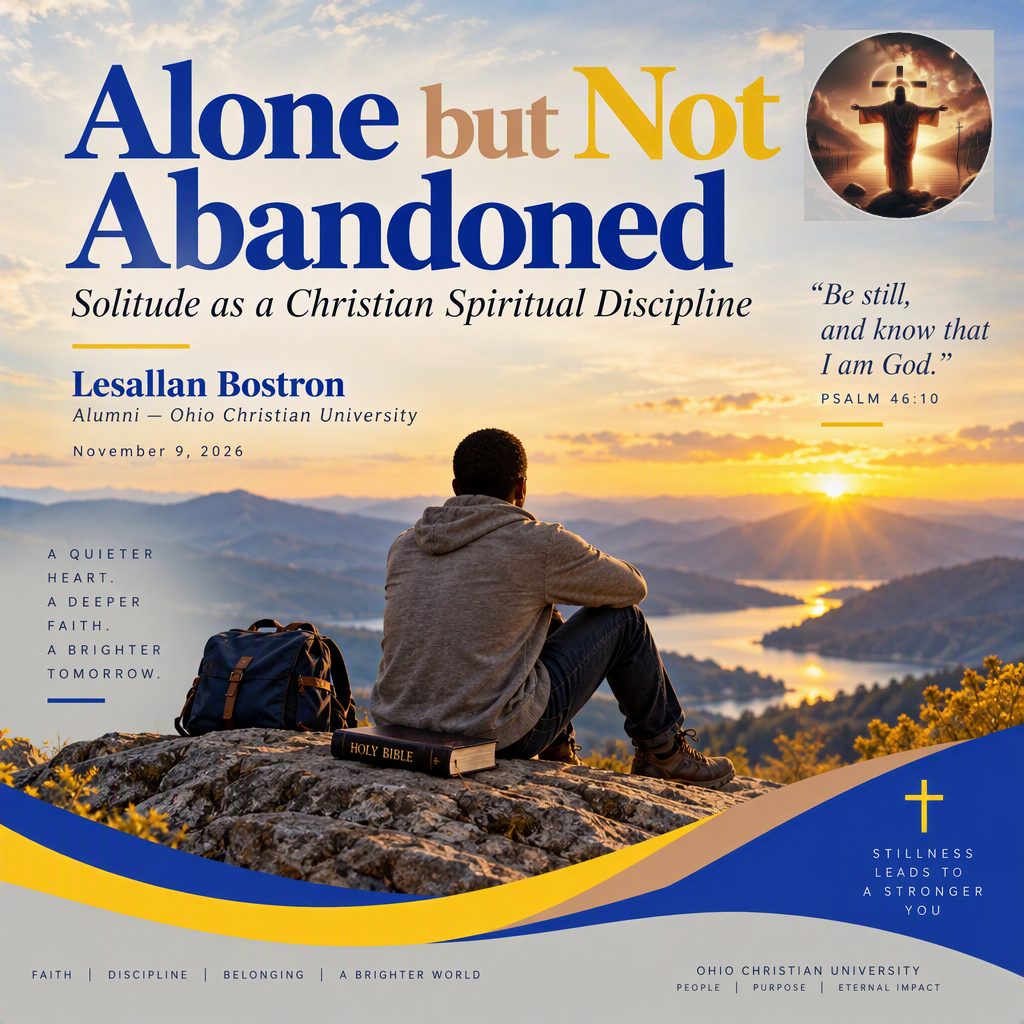
Alone but Not Abandoned: Solitude as a Christian Spiritual Discipline
There is a major difference between being alone and being abandoned. At different points in my life, particularly as I have grown older, retired, lived with disability, and experienced a quieter way of life, I have had to confront that distinction personally. The absence of constant activity and companionship can initially make life seem smaller. Yet my Christian faith has increasingly taught me that quietness does not necessarily indicate emptiness. Solitude can become a place in which the distractions of life diminish enough for prayer, reflection, and awareness of God’s presence to become more intentional. Contemporary scholarship likewise suggests that experiences of being alone are complex and may include both positive and negative dimensions (Borg & Willoughby, 2022).
From a Christian perspective, solitude has a particularly significant purpose. It is not merely separation from other people but an intentional opportunity to turn one’s attention toward God. Mathew (2022) describes silence and solitude as spiritual disciplines associated with Christian spiritual formation and emphasizes their deliberate character. This distinction matters because Christian solitude should not be understood as a rejection of community or a glorification of isolation. Instead, solitude can create an intentional space for prayer, self-examination, spiritual formation, and communion with God. When practiced purposefully and balanced with healthy relationships, Christian solitude can transform the experience of being alone from perceived abandonment into an opportunity for spiritual formation, deeper prayer, self-reflection, and renewed awareness of God’s presence. (Mathew, J. S., 2022).
Biblical Foundations of Christian Solitude
The Christian understanding of solitude is strongly illustrated in the life of Jesus Christ. The Gospels repeatedly portray Jesus withdrawing from crowds to pray. Luke 5:16 states, “And he withdrew himself into the wilderness, and prayed” (King James Bible, 1769/2017, Luke 5:16). Jesus’ withdrawal is significant because His solitude was intentional and spiritually directed. He did not withdraw because relationships were inherently undesirable. Rather, periods away from the crowds provided opportunities for prayer.
Mark 1:35 provides another example: “And in the morning, rising up a great while before day, he went out, and departed into a solitary place, and there prayed” (King James Bible, 1769/2017, Mark 1:35). The sequence described in this passage connects solitude directly with prayer. Jesus intentionally moved away from ordinary surroundings and human activity to spend time in communion with the Father.
These passages challenge the assumption that a spiritually meaningful life must always appear busy. Jesus ministered among people, taught crowds, healed individuals, and maintained relationships with His disciples, but His public ministry did not eliminate His private spiritual life. Solitude and community therefore need not be viewed as opposites. Rather, withdrawing and returning can become complementary movements within Christian life.
That biblical pattern has become increasingly meaningful to me. Retirement and disability have changed the rhythm of my daily life. I do not necessarily have the schedule, activity, or constant social interaction that may characterize other seasons of adulthood. There are circumstances in which this quiet life can feel isolating. However, the example of Christ encourages me to ask another question: Instead of asking only why I am alone, I can ask what I will do with the quiet I have been given.
That question shifts solitude from something that merely happens to me toward something I can sometimes practice intentionally.
Solitude Is different from Loneliness
An academic examination of solitude requires an important qualification: solitude and loneliness are not synonymous. Borg and Willoughby (2022) found that individuals interpret being alone in multiple ways, including physical separation, loneliness, positive experiences, and negative experiences. Likewise, Motta and Bortolotti (2020) distinguish solitude from loneliness and argue that positive solitude may support agency and authenticity. Their analysis characterizes solitude in terms of presence, whereas loneliness is characterized by absence (Motta & Bortolotti, 2020).
That distinction helps explain something I have learned through personal experience. There are moments when being physically alone feels lonely. Christianity should not romanticize those experiences or suggest that loneliness is automatically spiritually beneficial. At the same time, there are other moments when I can be alone without experiencing myself as abandoned. Prayer changes the meaning I give to the quiet. Reading Scripture, writing about faith, reflecting on my life, and intentionally directing my attention toward God can give purpose to time that might otherwise feel empty.
Recent psychological scholarship reinforces the idea that the experience of solitude depends partly on how a person relates to it. Rodriguez et al. (2023) studied individuals experiencing moderate-to-severe loneliness and found that participants who read about the potential benefits of solitude experienced a greater increase in low-arousal positive affect after a period of solitude than participants in the control condition. This finding does not establish solitude as universally beneficial, nor does it mean that loneliness can simply be thought away. It does, however, provide evidence that reframing solitude can influence how some lonely individuals experience time alone emotionally (Rodriguez et al., 2023).
This nuance is important to Christian spiritual practice. Christian solitude should not provide an excuse to deny legitimate loneliness, withdraw indefinitely from relationships, or assume that every form of isolation is spiritually healthy. Instead, intentional solitude and unwanted loneliness should be distinguished carefully.
Solitude as Spiritual Formation
Christian spiritual disciplines are purposeful practices rather than ends in themselves. In this context, solitude creates an environment in which attention can be redirected from external demands toward God. Mathew (2022) identifies silence and solitude as related disciplines associated with spiritual formation and knowing God. Suwala (2024), while examining silence and solitude across several worldviews, similarly notes that Christian practice may involve purposes such as communion with God and preparation for prayer.
For me, this is where solitude becomes deeply personal. Living a quieter life has forced me to face questions that busyness can sometimes postpone. Who am I when there is no audience? What gives my life meaning when I am no longer defined primarily by employment, productivity, or conventional expectations of success? What remains when parts of life I once took for granted change?
My Christian answer increasingly begins with identity rather than productivity. I am not valuable merely because of what I accomplish. Solitude creates room for me to reflect upon who I am before God.
Psalm 46:10 instructs, “Be still, and know that I am God” (King James Bible, 1769/2017, Psalm 46:10). In a personal sense, stillness requires me to surrender the idea that every moment must be filled with activity before it has value. It also gives me space to reconsider retirement and disability. They involve genuine limitations, but limitation does not necessarily mean the end of spiritual purpose.
This does not mean retreating permanently from the world. Spiritual formation should influence the way a Christian lives and relates to others. The quiet place can become preparation for prayer, writing, encouragement, ministry, compassion, and renewed engagement with other people. Solitude, properly understood, is therefore not simply withdrawal. It can become preparation for faithful presence.
Solitude, Spirituality, and Well-Being
Contemporary scholarship provides additional context for understanding why intentional solitude can be meaningful. Motta and Bortolotti (2020) review literature concerning the potential benefits of solitude related to freedom, creativity, and spirituality and argue that the relationship between the individual and the environment is important in determining the quality of solitude. Weinstein and Adams (2024) similarly emphasize that the possible benefits of solitude for well-being depend on contextual factors, including the function and purpose of solitude and the activities undertaken while alone. (Motta, V., & Bortolotti, L.,2020).
These findings complement the Christian understanding of intentionality. Simply sitting alone is not necessarily a spiritual discipline. Christian solitude becomes spiritually purposeful when an individual intentionally makes room for God through practices such as prayer, Scripture reading, reflection, and attentive stillness.
A broader connection also exists between spirituality and well-being. Ryff (2021) examines theoretical and empirical relationships among spirituality, religion, and eudaimonic well-being while emphasizing the importance of careful scientific investigation into these relationships. Consequently, it would be inappropriate to claim that Christian solitude automatically produces psychological well-being. The evidence supports a more careful position: spirituality and well-being can be related, while solitude itself is a nuanced experience whose outcomes depend upon context, purpose, and individual circumstances (Ryff, 2021; Weinstein & Adams, 2024).
This balance is particularly important in my own reflection. Faith does not require me to pretend that being alone is always easy. Some quiet days remain difficult. There are moments when solitude feels peaceful and others when the absence of companionship is noticeable. A mature understanding of Christian solitude must have room for both experiences.
Alone but Not Abandoned
The title Alone but Not Abandoned captures the theological distinction that has become most important to me. Physical solitude does not necessarily indicate divine absence. Hebrews 13:5 contains the promise, “I will never leave thee, nor forsake thee” (King James Bible, 1769/2017, Hebrews 13:5). That passage does not promise a life without lonely moments. It provides a theological basis, however, for believing that human aloneness is not equivalent to abandonment by God.
This belief changes how I understand a quieter stage of life. Retirement can remove professional roles. Disability can change what a person is physically able to do. Aging can change routines and relationships. None of these realities, however, necessarily removes spiritual purpose. For me, solitude has provided time to write, pray, reflect, and think more carefully about what God may be doing in this season of life.
There is also humility in solitude. Quiet removes some of the distractions that allow a person to avoid tough questions. In solitude, I can examine regrets, hopes, fears, gratitude, and unanswered prayers. Such reflection does not always produce immediate answers. Sometimes spiritual maturity may involve remaining faithfully present before God even when answers do not come quickly.
Solitude therefore becomes less about escaping the world and more about learning how to inhabit my life faithfully. I can be alone without believing I have been forgotten.
Conclusion
Christian solitude is neither a rejection of human community nor a denial of loneliness. Scripture demonstrates that Jesus intentionally withdrew for prayer, establishing a powerful biblical example of purposeful solitude (King James Bible, 1769/2017, Luke 5:16; Mark 1:35). Scholarship likewise shows that being alone is a complex experience whose meaning and effects depend partly upon purpose, context, interpretation, and the individual’s relationship to solitude (Borg & Willoughby, 2022; Motta & Bortolotti, 2020; Weinstein & Adams, 2024). Christian scholarship further identifies silence and solitude as practices associated with spiritual formation and communion with God (Mathew, 2022; Suwala, 2024).
My own experience gives these ideas personal meaning but does not replace the evidence supporting them. Retirement, disability, aging, and living a quieter life have taught me that solitude can carry more than one meaning. Sometimes being alone reveals a genuine need for companionship. At other times, it gives me an opportunity to pray, reflect, write, examine my life, and become more attentive to God’s presence. The goal is not to make loneliness sacred or isolation desirable. Instead, it is to recognize that a period of aloneness can become spiritually formative when it is approached intentionally and held alongside healthy relationships and Christian community.
I have discovered that quietness does not mean that my life has stopped, nor does being alone mean that God has departed. Sometimes the quiet place becomes the very place in which faith is examined, strengthened, and renewed. In that sense, Christian solitude carries a paradoxical message: I may sometimes be alone, but in Christ I need not understand myself as abandoned.
References:
Borg, M. E., & Willoughby, T. (2022). What does it mean to be alone? An analysis of interpretations of solitude among adolescents and adults. Current Psychology. https://doi.org/10.1007/s12144-022-02796-7
Mathew, J. S. (2022). The discipline of silence and solitude for spiritual formation. Journal of Emerging Technologies and Innovative Research, 9(8), d364–d369. https://www.jetir.org/papers/JETIR2208341.pdf
Motta, V., & Bortolotti, L. (2020). Solitude as a positive experience: Empowerment and agency. Metodo, 8(2), 119–147. https://doi.org/10.19079/metodo.8.2.119
Rodriguez, M., Pratt, S., Bellet, B. W., & McNally, R. J. (2023). Solitude can be good if you see it as such: Reappraisal helps lonely people experience solitude more positively. Journal of Personality, 93(1), 118–135. https://doi.org/10.1111/jopy.12887
Ryff, C. D. (2021). Spirituality and well-being: Theory, science, and the nature connection. Religions, 12(11), 914. https://doi.org/10.3390/rel12110914
Suwala, L. (2024). The practice of silence and solitude and its results [Senior honors thesis, Liberty University]. Liberty University Faculty SHARE. The Practice of Silence and Solitude and its Results – LU Faculty SHARE (Scholarship Hub & Research Exchange)
Weinstein, N., & Adams, M. (2024). The many ways of experiencing solitude: Personality processes, in context, as predictors of time alone. Journal of Personality, 93(1), 5–11. https://doi.org/10.1111/jopy.12968



0 Comments