Lesallan Bostron – June 10, 2024
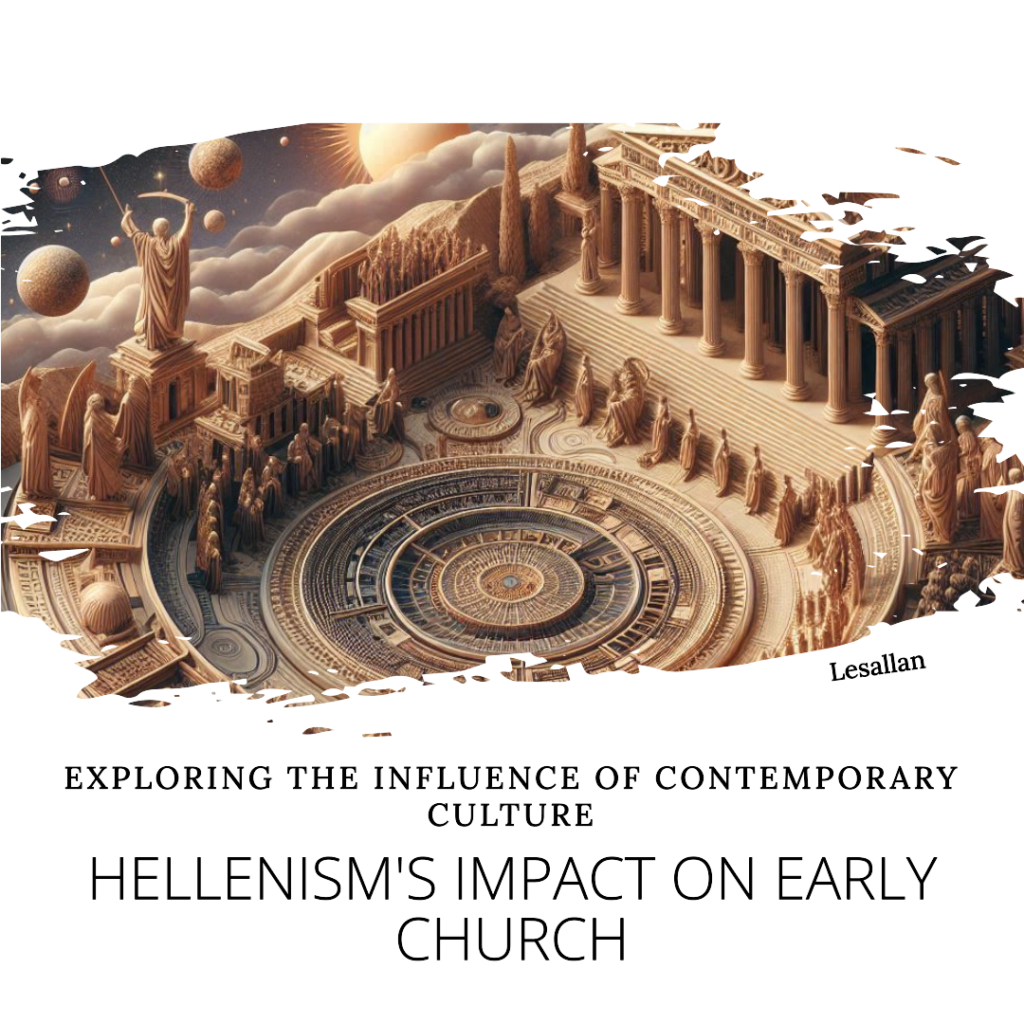
This is about Hellenism’s impact on the early church and the influence of contemporary culture on its development. Hellenism, the influence of Greek culture, language, and philosophy that spread across the Mediterranean world after Alexander the Great’s conquests, significantly shaped the early church. The spread of the Greek language and culture facilitated the communication and dissemination of Christian teachings across different regions. This helped translate and propagate the New Testament, ensuring a wider reach and understanding of Christian ideas. While influenced by Hellenism, it is remarkable to see how the early church maintained its core principles and adapted to the changing times.
Several philosophical concepts from Hellenism influenced early Christianity. Stoicism, which emphasized ethics, virtue, and self-control, aligned with Christian teachings on morality and righteous living. Platonism introduced ideas of the immortality of the soul and the existence of an ideal realm, resonating with Christian beliefs about the afterlife and God’s existence. However, there were also clashes between certain philosophical ideas and Christian doctrines. For instance, Epicurean philosophy, which focused on pursuing pleasure and avoiding pain, contradicted Christian teachings on self-denial and sacrificial love. This intellectual engagement with Hellenistic philosophy showcases the depth of early Christian thought.
Hellenistic culture influenced Christian art and architecture. Greek artistic techniques and architectural forms inspired by Hellenistic buildings became prominent features of early Christian churches. Despite these influences, the core tenets of Christian faith, such as the divinity of Jesus Christ and salvation through faith, remained unchanged.
In terms of contemporary culture, major changes have been apparent over the past 50 years, becoming more noticeable during momentous events like the COVID-19 pandemic. These cultural shifts have impacted the church in numerous ways. For instance, the church has had to adapt to changes in demographics, attitudes toward moral issues, and the development of modern technologies. These changes alter Christianity’s questions and concerns it must respond to.
The church’s culture is a dynamic environment that fosters varying levels of innovation. A healthy cultural foundation supports innovative ministries that cater to people’s strengths and needs, allowing the community to deeply experience Christ’s love and grace (Davis, n.d.). As such, the church continues evolving and adapting to the changing cultural landscape.
I hope this provides a comprehensive overview of Hellenism’s impact on the early church and contemporary culture’s influence on the church’s development.
Blessings,
Lesallan
References:
Davis, D. (n.d.). Modernity, Post-Modernity and the Church Today – Don Davis | Free. Www.biblicaltraining.org. Retrieved June 10, 2024, from https://www.biblicaltraining.org/learn/foundations/ch391-traditions-of-spirituality/ch391-03-modernity-post-modernity-and-the-church-today