Written By Les Allan – July 26, 2023
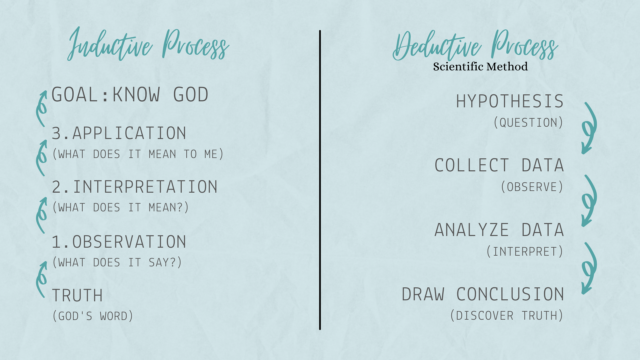
Inductive and Deductive Bible Study Methods
I understand that this topic may be repetitive for some, but I will try to clarify the distinction between an inductive and deductive approach when studying the Bible. Firstly, I will discuss Robert Traina’s inductive Bible study method and a notable scholar’s opinion. This method has taught students a crucial critical-thinking skill: how to read! (Bauer, 2013).
A method of studying the Bible called inductive study is known for emphasizing objective interpretation of the text, free from preconceived notions or biases. According to Bauer and Traina (2014), this approach requires radical openness to any conclusion supported by evidence from the Bible. The key is to be meticulous in observation and interpretation rather than rushing to conclusions. As Cater (2023) says, this lays a vital foundation for an accurate understanding of what God’s Word says without being influenced by our own presuppositions.
Turning to the deductive Bible study approach, this approach starts with a principle or teaching and attempts to find supporting passages. It emphasizes proof. The deductive Bible study involves starting with a preconceived idea or doctrine and then trying to find evidence to support it. The inductive Bible study provides analytical knowledge and understanding of the Bible, which is essential for building Bible doctrine. On the other hand, the deductive study researches deductively to build a doctrine, which informs inductive study about the broader doctrinal context of Scripture. This knowledge then enables the inductive study to draw out even more meaning from the text (Vis, 2022).
Both the inductive and deductive Bible study approaches have their strengths and weaknesses. The greatest strength of the inductive method is that it draws one into a personal collaboration with the Bible and, therefore, with God. The Bible is the primary source of information about the Bible. Using the inductive method will take the personal study of the Bible to a new level of understanding. One of the primary weaknesses of using the inductive Bible study method is that it takes time and requires practice. It requires careful attention to detail through observation and interpretation of the passage. It involves investigating and cross-referencing or using other resources such as commentaries or Bible dictionaries—finally, the application of the essential truths discovered through careful observation and interpretation to our own life.
The deductive approach to the study of the Bible has its own set of strengths and weaknesses. One of its strengths is that it saves time by going straight to the point. However, a weakness of this approach is that it does not require any new knowledge since all premises have already been tested. The conclusions have already been reached, and this method is simply used for verification, which can lead to dependence on other resources.
Blessings,
Lesallan
References:
Bauer, D. R., & Traina, R. A. (2014). Inductive bible study – a comprehensive guide to the practice of hermeneutics. Baker Publishing Group.
Bauer, D. R. (2013, June 29). Introducing Inductive Bible Study. Seedbed. https://seedbed.com/introducing-inductive-bible-study/
Cater, C. (2023, February 20). What Is Inductive Bible Study? Precept. https://www.precept.org/2023/02/what-is-inductive-bible-study/
Hildebrandt, T., & Bauer, D. (2016a, July 5). Dr. David Bauer, Inductive Bible Study, Lecture 4, Precise & Clear, Profound, whole book survey. Www.youtube.com. https://www.youtube.com/watch?v=C7_C1xwPQTo&t=1932s
Hildebrandt, T., & Bauer, D. (2016b, July 5). Dr. David Bauer, Inductive Bible Study, Lecture 5, Whole Book Survey. Www.youtube.com. https://www.youtube.com/watch?v=vtbkUx6w0VY&t=941s
Vis, D. (2022, April 11). Inductive vs Deductive Study. FAST Missions. https://www.fastmissions.com/article/inductive-vs-deductive-study