—Lesallan
University of Arkansas — Grantham
LD501 – Leadership Styles & Development
Dr. David McNamee
April 18, 2026
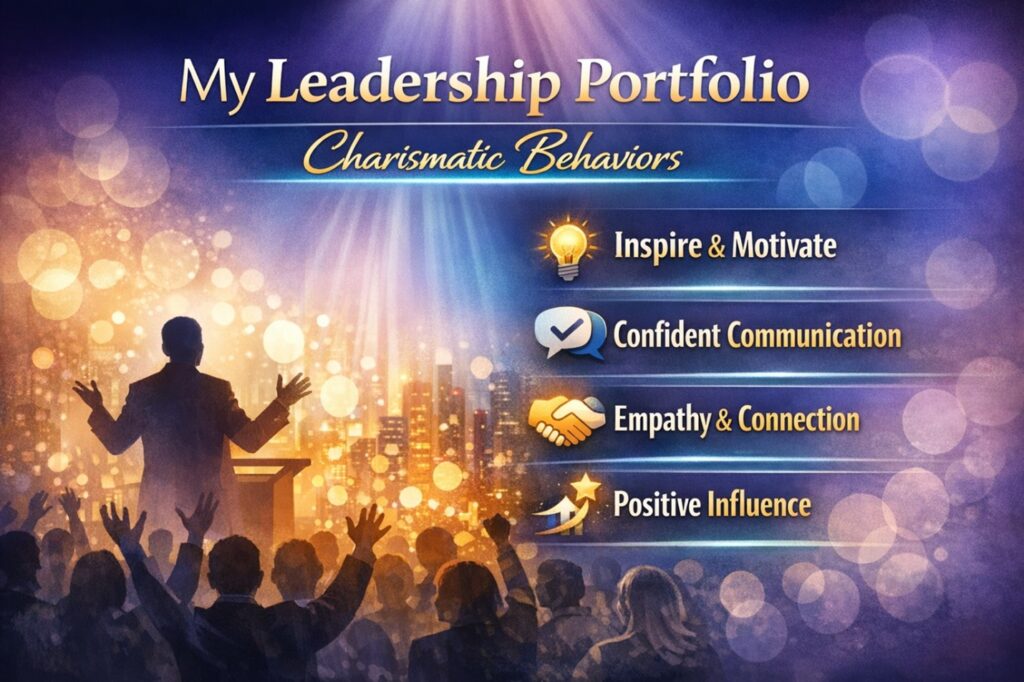
My Leadership Portfolio: Charismatic Behaviors
Over the past two weeks, I reflected on my interactions to identify behaviors that might be viewed as charismatic. Week one emphasized leadership as a relational process rooted in influence and communication, helping me see that charisma often appears through small, meaningful actions rather than dramatic displays (Northouse, 2022). With this perspective, I noticed myself greeting others warmly smiling, using their names, and showing genuine interest in their well‑being. These behaviors align with the interpersonal connection highlighted in Week 1 and reinforced in 10 Traits of Great Leaders, which identifies approachability and positivity as essential leadership traits (J5R Business Services, 2014).
Week two expanded into trait and behavioral leadership, noting that charismatic leaders express confidence, optimism, and the ability to connect others to a sense of purpose. I observed this when I reframed a routine task to highlight its broader significance, which increased engagement and encouraged more ideas. This reflects the Week 2 behavioral approach and the Core Leadership Theories video, which explains that effective leaders inspire by providing clear direction (Brighton School of Business and Management, 2014). I also volunteered for a challenging task others avoided, demonstrating commitment through action—an idea supported by Developing Human Potential, which emphasizes aligning actions with values to strengthen credibility (Matkin et al., 2023).
I further used expressive communication—varying tone, emphasizing key points, and using relatable examples—to help others connect emotionally with the message. This aligns with Herber’s TEDx talk, which encourages leaders to amplify influence by leaning into their natural strengths (Herber, 2013). Stevens’ leadership philosophy reinforced that leaders shape culture through consistent, intentional behaviors, helping me see how even small actions contributed to a more positive environment (Stevens, 2013).
Reflecting on these experiences from Weeks 1 and 2 showed me that charisma is not innate, but a set of intentional, learnable behaviors rooted in relational leadership. Warmth, vision framing, expressive communication, and symbolic action emerged naturally in my interactions, demonstrating how charismatic influence grows from foundational principles. Moving forward, I plan to practice these behaviors in ways that remain authentic, ethical, and aligned with the relational leadership model emphasized early in the course.
References:
Brighton School of Business and Management. (2014, July 10). Core leadership theories [Video]. YouTube. https://www.youtube.com/watch?v=SRrC67py-4E
Herber, E. K. (2013, August 13). Focusing on strengths [Video]. TEDx Talks. https://www.youtube.com/watch?v=t9ED7t2VeJI
J5R Business Services. (2014, April 24). 10 traits of great leaders [Video]. YouTube. https://www.youtube.com/watch?v=Tv6c6KCO36w
Matkin, G. S., et al. (2023). Developing human potential: A personal approach to leadership. Open Textbook Library. https://open.umn.edu/opentextbooks/textbooks/1471
Northouse, P. G. (2022). Leadership: Theory and practice (9th ed.). SAGE Publications.
Stevens, G. (2013, November 26). Leadership philosophy [Video]. Army Medicine. https://www.youtube.com/watch?v=UVEiWcUCF4Q