Lesallan – May 31, 2024
Ohio Christian University
THE2300 Historical Theology I (ONLSP242)
Dr. Trent Lambert
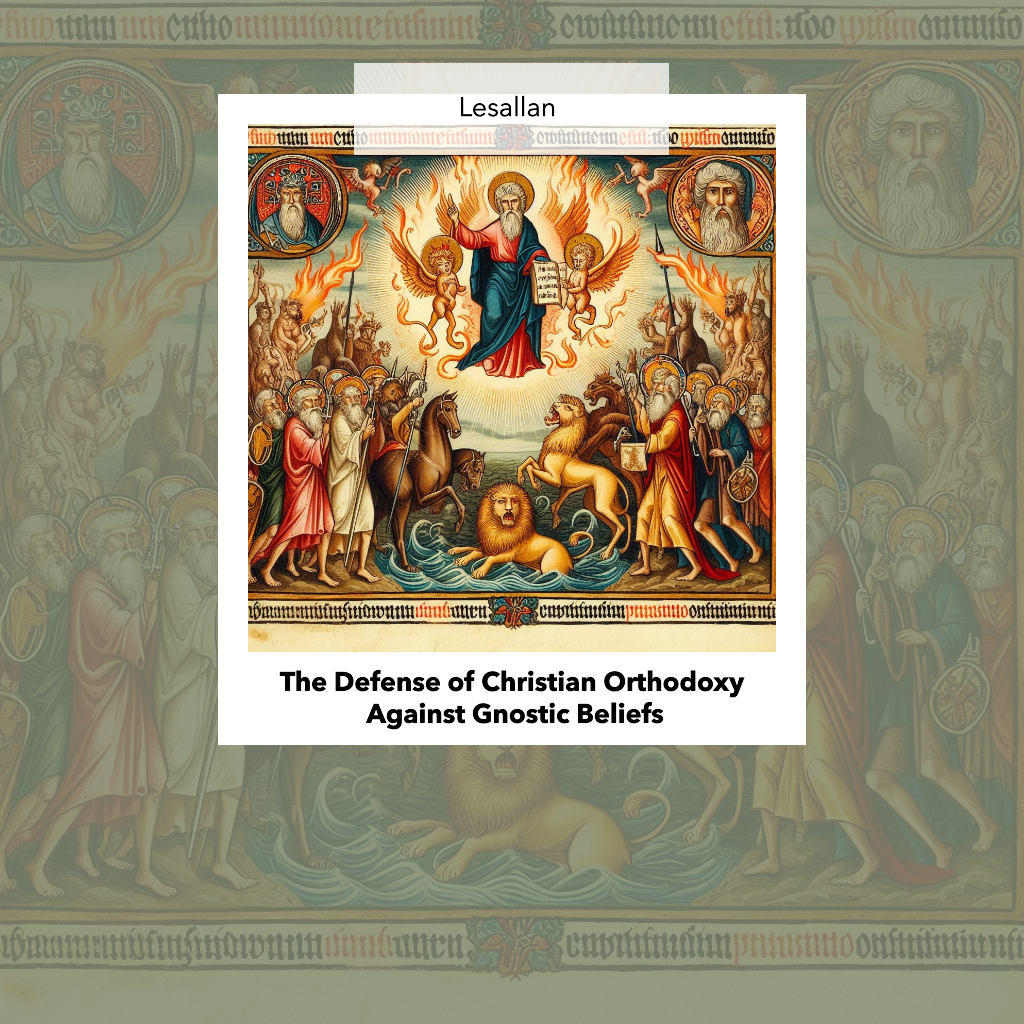
The Defense of Christian Orthodoxy Against Gnostic Beliefs
In the early years of Christianity, the church grappled with a multitude of challenges that posed a threat to its core beliefs and practices. One such challenge was the rise of Gnosticism, a movement known for its secretive approach to salvation and its fusion of Greco-Roman philosophy, religion, and Christian teachings. Irenaeus of Lyons, a prominent bishop and theologian of the second century, confronted this threat head-on in his comprehensive theological treatise, ‘Against Heresies’ (Justin Martyr, St., 1885). This essay delves into the key issues raised by Irenaeus, the prominence of the rule of faith in his writings, and the intriguing aspects of his defense of Christian orthodoxy, underscoring the enduring significance of his work in the history of Christian theology.
Irenaeus’ Confrontation with Gnostic Beliefs. Irenaeus’ work is a meticulous documentation and refutation of Gnostic beliefs. He identifies the unity of God as a fundamental tenet of Christian doctrine, challenging the Gnostic dualistic worldview that posited a lesser, malevolent deity responsible for creation (Justin Martyr, St., 1885).
One of the key points of divergence between Irenaeus and the Gnostics is their views on the material world. While the Gnostics saw the physical realm as inherently corrupt, Irenaeus staunchly affirmed its goodness. Furthermore, he firmly established the canonical status of the Gospels according to Matthew, Mark, Luke, and John, thereby rejecting the legitimacy of the various Gnostic texts that sought to distort the Christian message (Justin Martyr, St., 1885).
At the heart of Irenaeus’s argument is the rule of faith, which he presents as an apostolic tradition that serves as a bulwark, safeguarding the integrity of Christian doctrine (Justin Martyr, St., 1885). This rule encapsulates the belief in one God, the incarnation of Jesus Christ, and the resurrection of the flesh—fundamental principles that sharply contrast with the Gnostic emphasis on the secret knowledge as the path to salvation. Irenaeus leverages the rule of faith to scrutinize and discredit Gnostic teachings, thereby highlighting the continuity of the Old and New Testament revelations and the universal accessibility of salvation through faith (Justin Martyr, St., 1885).
The Enduring Significance of Irenaeus’ Theological Contributions. What is particularly noteworthy about Irenaeus’ approach is his systematic exposition of Gnostic doctrines before their refutation. His writings provide invaluable insights into the diversity of early Christian thought and intellectual battles waged by the church to preserve the purity of its teachings. Irenaeus’s defense of the physical world’s sanctity and the coherence of the Christian narrative offers a persuasive argument for the consistency and unity of the Christian faith (Justin Martyr, St., 1885).
In summary, Irenaeus’ “Against Heresies” is a pivotal text in the history of Christian theology. His robust defense of fundamental Christian beliefs against the distortions of Gnosticism played a crucial role in shaping the theological foundations of the church. His treatise records the doctrinal disputes of his era and imparts the timeless wisdom on the principles that undergird the Christian faith. As delineated by Irenaeus, the rule of faith stands as a testament to the early church’s unwavering commitment to the apostolic tradition and its relevance for contemporary theological discourse (Justin Martyr, St., 1885).
References:
Justin Martyr, St. (1885). Philip Schaff: ANF01. The Apostolic Fathers with Justin Martyr and Irenaeus – Christian Classics Ethereal Library. Ccel.org. https://ccel.org/ccel/schaff/anf01.toc.html


