Lesallan – June 11, 2024
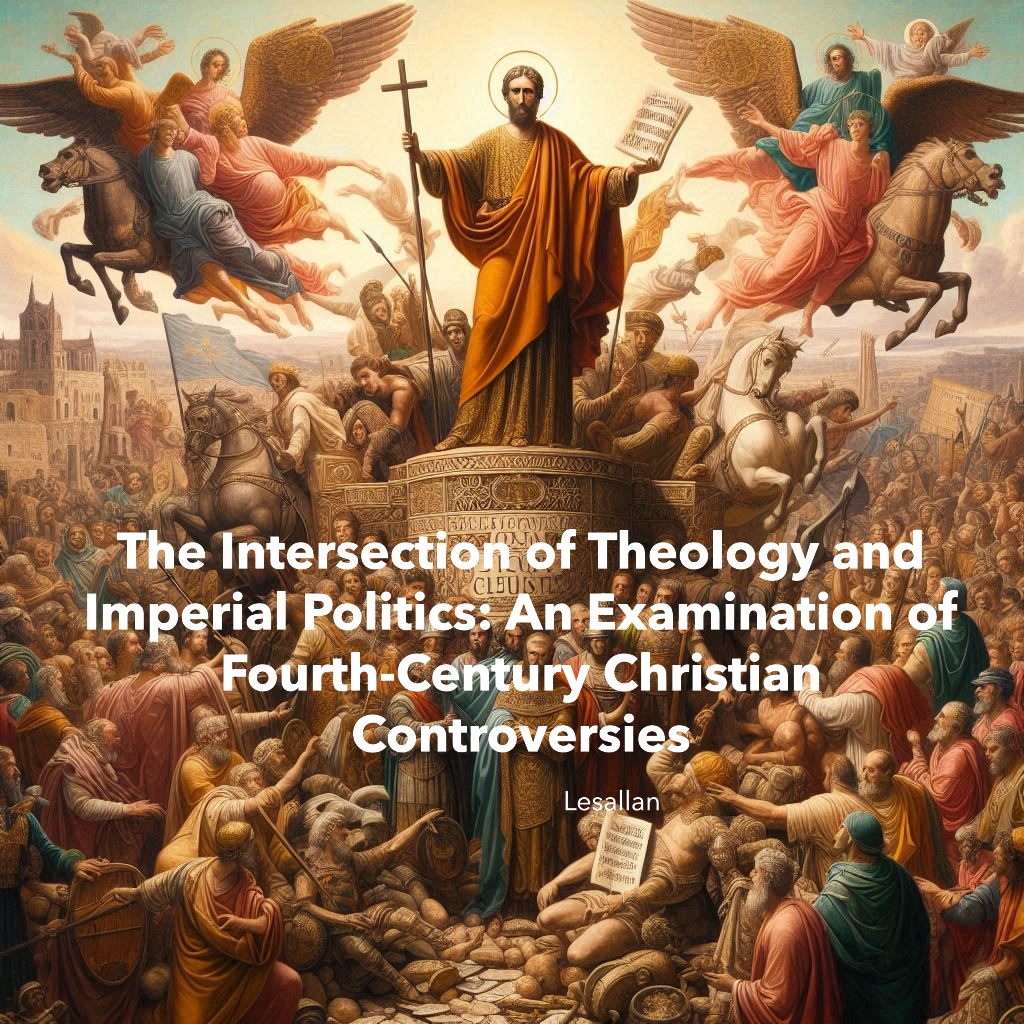
The Intersection of Theology and Imperial Politics: An Examination of Fourth-Century Christian Controversies
Lesallan Bostron
Ohio Christian University
THE2300 Historical Theology I (ONLSP242)
Dr. Trent Lambert
June 11, 2024
The fourth century marked a significant turning point in the history of the Christian Church, characterized by intense theological controversies and the profound influence of Imperial politics (Shelley, 2021). This discussion will explore these dynamics, focusing on the main controversies of the time, the role of politics in shaping these discussions, and the impact of Imperial politics on the Church.
The major theological disputes of the fourth century were the Arian controversy and the Donatist schism (Shelley, 2021). The Arian controversy centered on the nature of the Son of God. Arius, a presbyter from Alexandria, vigorously argued that the Son was a created being and not co-eternal with God the Father. This belief was contested and condemned at the Council of Nicaea in 325, which affirmed that the Son of God shares the same essence as the Father (Piper, 2006).
On the other hand, the Donatist schism emerged from a disagreement regarding the validity of sacraments performed by clergy members who had abandoned their faith during the Diocletian persecution (Shelley, 2021). The Donatists argued that the effectiveness of the sacraments hinged on the moral integrity of the minister. This view was at odds with the mainstream Church, which maintained that the validity of the sacraments was established by Christ himself, not dependent on the worthiness of the minister (Shelley, 2021).
Imperial politics played a crucial role in shaping these theological discussions (Shelley, 2021). With Emperor Constantine’s conversion to Christianity, the Church was thrust into the realm of Imperial politics. The emperor used his influence to enforce the orthodoxy, suppress heresy, and maintain ecclesiastical unity. Theological debates became intertwined with political discourse, and the empire’s stability was often linked to resolving these controversies (Shelley, 2021).
The involvement of Imperial politics in Church affairs had both positive and negative effects (Shelley, 2021). On the one hand, the Church gained legal status and protection under Emperor Constantine, significantly increasing conversions. The emperor’s involvement in theological disputes, such as his role in convening and presiding over the Council of Nicaea, helped enforce orthodoxy and maintain unity within the Church (Piper, 2006).
On the other hand, the Church’s close association with the state led to an influx of converts seeking to advance their careers rather than out of genuine faith (Shelley, 2021). Furthermore, the Emperor’s involvement in theological matters risked turning the Church into a department of the state, a phenomenon known as Caesaro-Papism (Shelley, 2021).
In summary, the fourth century was a period of intense theological debate within the Church, significantly influenced by Imperial politics (Shelley, 2021). While this political involvement brought certain benefits, it also introduced new challenges and risks. The Church’s navigation through these complexities has impacted its development and identity (Shelley, 2021). The intertwining of theology and politics during this period serves as a reminder of the complex relationship between religion and state power (Shelley, 2021).
Blessings,
Lesallan
References:
Piper, J. (2006). Contending for our all: defending truth and treasuring Christ in the lives of Athanasius, John Owen, and J. Gresham Machen. Crossway Books.
Shelley, B. (2021). Church History in Plain Language (5th ed.). Zondervan Academic.


3 Comments
YqJcLjrQNvEiIF · June 13, 2024 at 12:34 pm
kdNQibgYr
yvhdneBpWYz · June 13, 2024 at 12:35 pm
MsYAzgDLRSWa
car rental service in Berlin · June 18, 2024 at 4:13 am
What a remarkable article! The way you’ve tackled the topic with such precision and depth is commendable. Readers are sure to gain a great deal from the wealth of knowledge and practical insights you’ve shared. Your profound understanding of the subject shines through every part of the piece. I’m eager to see more of your exceptional work. Thank you for offering your expertise and providing us with such enlightening and comprehensive content.
Comments are closed.