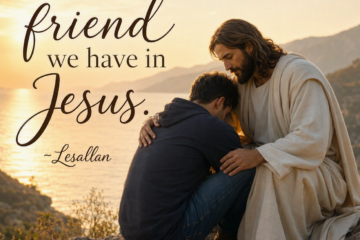
Written by Lesallan | September 23, 2025

When Compassion Isn’t Enough: A Christian Reflection on Euthanasia
“Speak up for those who cannot speak for themselves,
for the rights of all who are destitute”
(Proverbs 31:8, NKJV).
In a world that prizes autonomy and fears suffering, euthanasia is often framed as mercy. But Scripture calls us to a more profound compassion—one that does not end life but honors it.
As Exodus 20:13 declares, “You shall not murder” (NKJV), and Norman Geisler reminds us that “God alone has the right to take innocent life” (Geisler, 2010, p. 144). Ending life, even to relieve pain, crosses a line that Scripture never permits.
We are reminded in Genesis 1:27 that every person is created in God’s image, and Psalm 139:13–14 celebrates that we are “fearfully and wonderfully made” (NKJV). Life is sacred from beginning to end.
Proverbs 31:8 urges advocacy for the vulnerable (Prov. 31:8, NKJV), and John 10:10 assures us that Christ came “that they may have life, and that they may have it more abundantly” (NKJV).
Philosopher Anthony Weston warns that euthanasia erodes trust in caregivers and treats people as problems to be solved (Weston, 2011, p. 89). However, we are not problems; we are image-bearers. Genuine compassion means presence, dignity, and care. It means walking alongside suffering, not ending someone’s story. As Paul exhorts, “Bear one another’s burdens, and so fulfill the law of Christ” (Galatians 6:2, NKJV), and we follow the “God of all comfort, who comforts us in all our tribulation” (2 Corinthians 1:3-4, NKJV).
In many cultures across the Global South, life and death are communal journeys. Elders are honored, suffering is shared, and death is never rushed. Romans 12:15 calls us to “Rejoice with those who rejoice, and weep with those who weep” (NKJV). What if the church became a place where suffering was met with presence, not silence? What if we learned from these traditions and embodied a countercultural witness of hope and dignity?
Reflection Questions
• How does your view of suffering shape your response to euthanasia?
• What does it mean to treat someone as an “end,” not a “means” (Weston, 2011, p. 45)?
• How can your community offer dignity to those nearing death?
Closing Prayer
Lord, teach us to honor life, even in the midst of suffering. Please help us to be present, compassionate, and faithful. May we never rush what You hold sacred. Amen.
References
Geisler, N. L. (2010). Christian ethics: Contemporary issues & options (2nd ed.).
Baker Academic.
The Holy Bible: New King James Version. (1982). Thomas Nelson.
Weston, A. (2011). A practical companion to ethics (4th ed.).
Oxford University Press.