Lesallan | October 25, 2025
Christian Ethical Reflection on Civil Disobedience
Civil disobedience has always been a subject that presses deeply on my conscience as a believer. I find myself wrestling with the tension between honoring the civil authorities God has placed over us and remaining faithful to His higher moral law when the two come into conflict. In a recent letter, I shared some of these reflections, hoping to frame the issue not in terms of rebellion but in terms of obedience to Christ.
My Commitment to Peaceful Protest
I sincerely appreciate others’ framing of civil disobedience through biblical submission and God’s law. Their perspective reminded me that any act of resistance must remain peaceful. For me, this has meant ensuring that my actions are rooted in prayer, careful reasoning, and the encouragement of my Christian community. I know how easy it is to let frustration drive us, but I have learned that true witness comes when my choices are anchored in faith and obedience, not in anger.
Learning from Norman Geisler
Norman Geisler’s Christian Ethics: Contemporary Issues & Options (Geisler, 2010) has been a helpful guide for me. He reminds us that while God ordains government, its authority is not absolute. When human laws require us to disobey God’s higher moral law, resistance may be necessary.
I have taken to heart his insistence that such resistance must be:
Nonviolent – never seeking to harm, but to bear witness.
Conscientious – grounded in conviction, not personal preference.
Willing to accept consequences – even legal penalties, which strengthen the credibility of the testimony.
This framework resonates with my conviction that, when necessary, civil disobedience must be carried out with humility and courage, not defiance.
Guided by Scripture
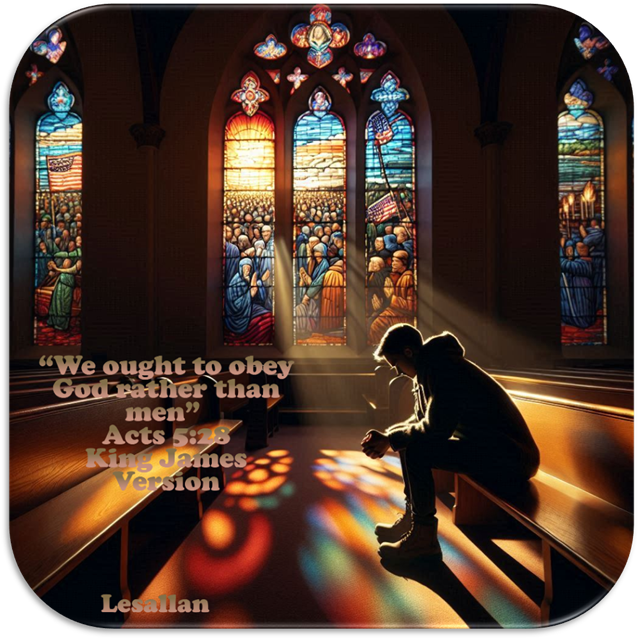
The verse that continually shapes my thinking is found in the book of Acts: “We ought to obey God rather than men” (Acts 5:28, King James Version). This scripture has become a compass for me. It reminds me that when obedience to human authority collides with obedience to God, my allegiance must remain with Him.
The Church’s Responsibility
As I reflect on these matters, I find myself asking: What is the church’s role in all of this? It is not enough for the church to simply protest unjust laws. I believe the church must also prepare believers—spiritually and practically—for the sacrifices that may be required by civil disobedience.
That preparation involves:
Spiritual formation – cultivating prayer, humility, and courage.
Practical readiness – equipping believers to face consequences with grace.
Community support – ensuring no one stands alone in the struggle.
This is the vision I long to see: a church that not only speaks truth to power but also strengthens its people to endure faithfully when obedience to God comes at a cost.
For me, civil disobedience is not about defiance; it is about discipleship. It is about bearing witness to the higher law of God with peace, conviction, and a willingness to accept the cost of obedience—many Blessings.
Lesallan
References:
Bostron, L. (2025, October 25). A Christian Perspective on Civil Disobedience – A Journey In Life. Thechristianthing.com. https://thechristianthing.com/a-christian-perspective-on-civil-disobedience/ A Christian Perspective on Civil Disobedience – A Journey In Life
Geisler, N. L. (2010). Christian Ethics: Contemporary Issues & Options (2nd ed.). Baker Academic.