Lesallan Bostron
University of Arkansas – Grantham
LD520 Critical Comm & Leadership (10/Jun/2026 – 04/Aug/2026 [001])
Dr. Craig Nathans
June 17, 2026
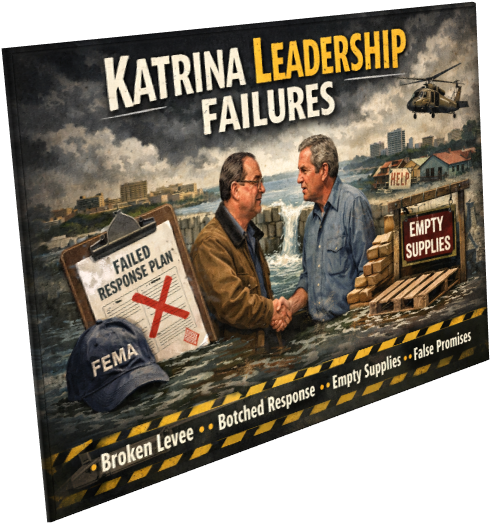
Aligning Actions with Words: Leadership Failures During Hurricane Katrina
Opening
On August 29, 2005, Hurricane Katrina made landfall on the Gulf Coast and precipitated one of the most catastrophic natural-disaster responses in modern U.S. history. The storm surge and subsequent levee breaches flooded 80% of New Orleans, leaving thousands stranded without timely rescue, shelter, or basic services (PBS Frontline, 2006). In the days and weeks that followed, public statements from federal and state leaders repeatedly promised rapid, decisive action; yet the operational reality on the ground was slow, disorganized, and insufficient. The gap between rhetoric and reality—between words intended to reassure and actions required to save lives—became a defining feature of the response and a central reason public trust eroded so quickly. This paper analyzes how the Katrina response demonstrated failures to align actions with words, compares and contrasts three principal ways leadership fell short, evaluates whether some public comments were merely rhetorical “feel-good” statements, and concludes with recommendations for how leaders could have rebuilt or earned public trust.
Communication Promises Versus Operational Reality
One of the most visible failures was in public communication. Federal and state leaders repeatedly issued statements intended to reassure the public that help was on the way and that the situation was under control. For example, senior officials publicly pledged rapid federal support and emphasized that resources would be mobilized immediately (White House, 2006). However, media coverage and eyewitness testimony documented lengthy delays in rescue operations, shortages of food and water, and chaotic conditions at shelters such as the Superdome and Convention Center (PBS Frontline, 2006). The discrepancy between public assurances and observable conditions created a credibility gap: when leaders said that the federal government was “doing everything in our power,” many citizens saw little evidence of that commitment in the form of timely rescues or visible federal presence (House Select Committee, 2006). The mismatch between reassuring language and the lived experience of survivors amplified anger and distrust.
The communication failure had two interrelated dimensions. First, leaders sometimes framed messages to calm the public rather than to convey the full scope of operational challenges. Officials later acknowledged that some public statements downplayed problems to avoid panic (White House, 2006). Second, the timing and content of messages were inconsistent across agencies and levels of government. Conflicting statements from local, state, and federal officials about who was in charge and what resources were available created confusion for both responders and the public (GAO, 2006). In short, words intended to stabilize the situation instead highlighted the absence of coordinated action.
Coordination and Authority: Promises of Unified Command That Did Not Materialize
A second major area where words and actions diverged was in the establishment and exercise of a clear chain of command. Public statements emphasized a unified, intergovernmental response under the National Response Plan and suggested that federal, state, and local authorities were working in concert (White House, 2006). In practice, however, responsibility for key decisions—such as the deployment of the National Guard, the use of military assets, and the prioritization of rescue missions—was contested or unclear. Investigations and oversight reports documented prolonged disputes over authority, delays in approving requests for assistance, and confusion about which agency had operational control in critical early hours (GAO, 2006; House Select Committee, 2006).
This failure of coordination had concrete consequences. When authority is ambiguous, decision-making slows; when decision-making slows during a rapidly evolving disaster, lives are at stake. The House Select Committee’s report and other reviews found that the National Response Plan’s implementation suffered from unclear roles and inadequate mechanisms for rapid federal intervention when state and local capacities were overwhelmed (House Select Committee, 2006). Thus, the rhetoric of “unified command” was not matched by the institutional capacity or the practiced relationships necessary to make unified command effective in the field.
Resource Deployment and Logistics: Assurances of Capacity Versus Shortfalls in Execution
A third critical divergence between words and deeds involved resource deployment and logistics. Leaders repeatedly assured the public that sufficient resources, personnel, supplies, and transportation—were being mobilized. Yet logistical bottlenecks, inadequate pre-positioning of supplies, and slow distribution meant that many survivors waited days for basic necessities (PBS Frontline, 2006). The Government Accountability Office (GAO) and other reviews identified shortcomings in surge capacity, supply-chain management, and the ability to move assets into the disaster zone quickly (GAO, 2006). In some cases, assets existed but were not effectively coordinated or prioritized; in others, assets were simply not available because of prior organizational decisions that had weakened FEMA’s readiness.
The gap between promises of resource sufficiency and the reality of shortages was particularly damaging because it was visible and immediate. People trapped on rooftops or in shelters could directly compare leaders’ assurances with the absence of food, water, and medical care. The tangible nature of these failures made the rhetoric seem hollow and contributed to the perception that leaders were either out of touch or unwilling to marshal the necessary resources.
“Feel-Good” Comments and Their Consequences
Throughout the response, several public comments functioned more as short-term morale boosters than as accurate reflections of operational realities. The most infamous example was President Bush’s remark to FEMA Director Michael Brown— “Brownie, you’re doing a heck of a job”—delivered while images of stranded citizens circulated widely (PBS Frontline, 2006). Such comments may have been intended to signal confidence and to support subordinates publicly, but when they were not backed by visible results, they appeared tone-deaf. Similarly, assurances that the federal government had the situation “under control” or that help was arriving “as fast as possible” felt comforting in the moment but were quickly undermined by the slow pace of rescues and the scale of unmet needs (White House, 2006).
Why do such comments persist? In crisis communication, leaders often attempt to project calm and control to prevent panic and to maintain public order. Short-term calming rhetoric can be useful if it is truthful and accompanied by rapid, observable action. However, when calming statements are not matched by action, they become counterproductive: they erode trust, invite scrutiny, and can intensify public anger. In Katrina’s case, many of the “feel-good” comments were not maliciously deceptive but were instead examples of optimistic framing that failed to account for operational constraints and the lived reality of victims (Tierney et al., 2006).
How Leadership Could Have Earned Public Trust
Rebuilding or earning public trust in the aftermath of Katrina would have required aligning words with demonstrable actions across communication, coordination, and logistics. First, leaders should have adopted transparent, evidence-based communication practices: acknowledge the scale of the problem honestly, provide regular updates on what is being done, and set realistic expectations about timelines and limitations. Transparency about constraints—paired with a clear plan for overcoming them—would have been more credible than premature assurances of control (GAO, 2006).
Second, clarifying and exercising a single, well-understood chain of command is essential. The National Response Plan and subsequent White House lessons emphasized the need for clear roles and responsibilities, implementing those clarifications in training, exercises, and pre-established agreements would have reduced delays and confusion (White House, 2006). A visible, empowered federal coordinator working in close partnership with state and local leaders could have reduced jurisdictional disputes and sped decision-making.
Third, leaders needed to invest in logistics and surge capacity before disaster struck. Pre-positioning supplies, maintaining robust transportation agreements, and ensuring that FEMA and partner agencies had the personnel and equipment to surge rapidly would have translated promises into action (GAO, 2006). Finally, accountability matters: when promises are missed, leaders should acknowledge failures, explain corrective steps, and follow through. Demonstrated accountability—through corrective action, personnel changes where appropriate, and measurable improvements—helps restore credibility over time (House Select Committee, 2006).
Conclusion
Hurricane Katrina exposed a painful mismatch between the words of leaders and the actions required to protect and assist citizens in crisis. Communication that reassured without reflecting operational realities, promises of unified command that were not matched by clear authority, and assurances of resource sufficiency that were undermined by logistical shortfalls together produced a crisis of confidence. Some public comments functioned as “feel-good” rhetoric that temporarily comforted audiences but damaged credibility when not supported by action. To earn public trust, leaders must align rhetoric with transparent communication, clarified authority, robust logistical preparedness, and accountable follow-through. The lessons of Katrina remain relevant: in disaster response, words matter only as far as they are backed by timely, effective action.
References:
Government Accountability Office. (2006). Hurricane Katrina: GAO’s preliminary observations regarding preparedness, response, and recovery (GAO‑06‑442T). U.S. Government Accountability Office. https://www.gao.gov/products/GAO-06-442T
House Select Bipartisan Committee to Investigate the Preparation for and Response to Hurricane Katrina. (2006). A failure of initiative: Final report of the Select Bipartisan Committee to Investigate the Preparation for and Response to Hurricane Katrina (H. Rept. 109‑377). U.S. House of Representatives. https://www.govinfo.gov/content/pkg/CRPT-109hrpt377/pdf/CRPT-109hrpt377.pdf
PBS Frontline. (2006). The Storm [Documentary]. Public Broadcasting Service. https://www.pbs.org/wgbh/frontline/film/storm/
The White House. (2006). The federal response to Hurricane Katrina: Lessons learned. Executive Office of the President. https://georgewbush-whitehouse.archives.gov/reports/katrina-lessons-learned.pdf
Tierney, K., Lindell, M. K., & Perry, R. W. (2006). Facing the unexpected: Disaster preparedness and response in the United States. Joseph Henry Press. https://www.nap.edu/catalog/11671/facing-the-unexpected-disaster-preparedness-and-response-in-the-united-states



0 Comments