Lesallan Bostron
University of Arkansas – Grantham
LD520 – Critical Comm & Leadership
Dr. Craig Nathanson
June 14, 2026
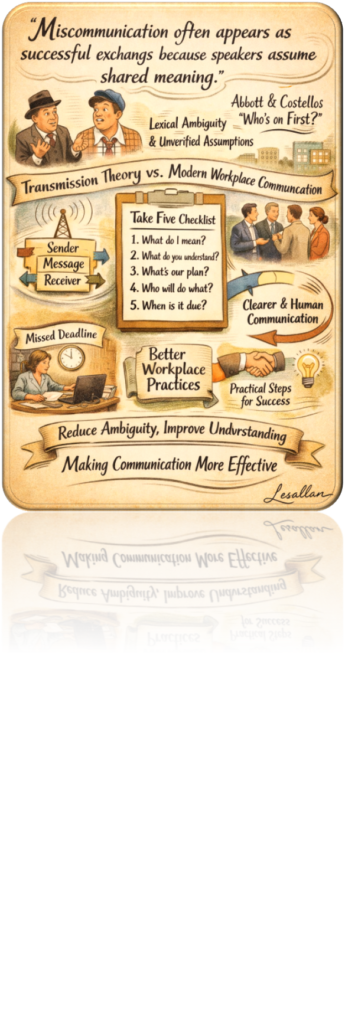
Take Five Before You Communicate: Understanding Audience Awareness and the Causes of Miscommunication
Lesallan Bostron
University of Arkansas – Grantham
LD520 – Critical Comm & Leadership
Dr. Craig Nathanson
June 14, 2026
Take Five Before You Communicate: Understanding Audience Awareness and the Causes of Miscommunication
Abstract
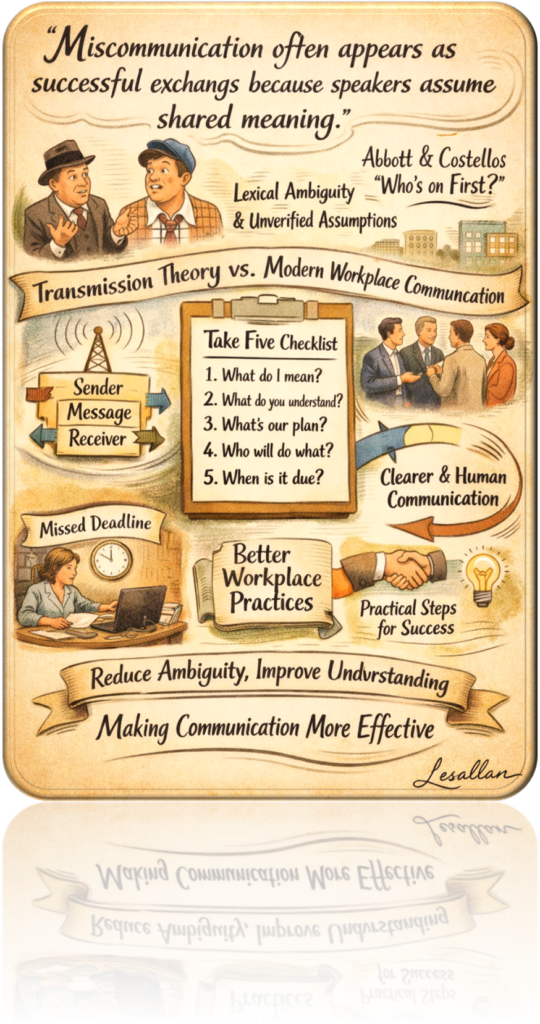
Miscommunication often appears as successful exchange because speakers assume shared meaning. Abbott and Costello’s “Who’s on First?” (Abbott & Costello Who’s on First, 2012) routine dramatizes how lexical ambiguity and unverified assumptions create the illusion that communication has occurred when it has not. This paper synthesizes classic transmission theory and contemporary management communication guidance to explain why miscommunication persists, presents a practical five‑question “Take Five” checklist to reduce ambiguity, and offers recommendations for workplace practice. A brief personal vignette illustrates how a small ambiguity produced a missed deadline and how the Take Five routine would have prevented it. The paper concludes with actionable steps organizations and individuals can adopt to make communication clearer, more human, and more effective.
Introduction
Communication is central to organizational effectiveness, yet it frequently fails in subtle ways. Thesis: Miscommunication often appears as successful exchange because speakers assume shared meaning; using the “Take Five” checklist—who the audience is, what they know, how they feel, what action is wanted, and what would make it easy—reveals hidden assumptions, reduces ambiguity, and prevents the costly breakdowns dramatized in Abbott and Costello’s “Who’s on First?”. Classic transmission models (e.g., Shannon & Weaver, 1949) highlight technical and semantic noise, while management communication scholarship emphasizes audience analysis and message design to prevent breakdowns (Thomas, Haupt, & Spackman, 2017). This paper uses the Abbott and Costello routine as a case study to show how lexical ambiguity and unverified assumptions produce rapid miscommunication and demonstrates how a brief pre‑send routine can reduce those risks.
Theoretical Background: Transmission, Meaning, and the Illusion of Understanding
Shannon and Weaver’s (1949) model conceptualizes communication as the transmission of a message from sender to receiver through a channel, subject to noise that can distort the signal. The model is foundational for understanding technical noise and semantic problems, but it is limited when applied to human meaning‑making because it treats meaning as a property of the message rather than a co‑constructed outcome of interaction. Contemporary management communication texts argue that effective workplace communication requires attention to context, shared frames of reference, and audience needs (Thomas et al., 2017). The “illusion of communication” occurs when senders believe they have transmitted meaning and receivers appear to respond, yet both parties operate with different referents or assumptions—producing the appearance of understanding without its substance.
Empirical research supports the claim that people often fail to detect incoherence in conversation. Laboratory studies that introduce incoherence or mismatched referents into dialogues find that a substantial portion of participants do not notice the mismatch, indicating that the illusion of understanding is common and not merely anecdotal (Galantucci & Roberts, 2014). This empirical finding helps explain why everyday exchanges can appear successful while producing errors that have real operational consequences.
“Who’s on First?”: Lexical Ambiguity and Failure to Verify Meaning
Abbott and Costello’s “Who’s on First?” is a comedic sketch built entirely on lexical ambiguity and mismatched referents. The routine’s humor depends on the baseball players’ names—Who, What, I Don’t Know—being ordinary question words. Each speaker assumes the other is using the same referent for the words exchanged; neither checks for shared meaning. The result is a rapid escalation of confusion that feels plausible because both participants behave as if they are answering straightforward questions. The sketch therefore dramatizes two common communication traps: (1) lexical ambiguity, where a single word has multiple possible meanings depending on context, and (2) failure to verify understanding, where interlocutors do not pause to confirm that terms and expectations are shared. As a teaching tool, the skit makes visible how easily everyday language can produce the illusion that communication has occurred when it has not.
In organizational contexts, similar traps appear in more mundane forms: ambiguous role descriptions, unspecified deadlines, and jargon that different groups interpret differently. The comedic exaggeration in the skit helps learners recognize the same dynamics in real workplace interactions and motivates the adoption of corrective practices such as explicit definitions and confirmation checks.
Why Miscommunication Persists in Everyday and Organizational Contexts
Several cognitive and social factors explain why miscommunication persists. First, people rely on cognitive shortcuts and assumptions of common ground to conserve effort; assuming shared meaning is efficient when it works but risky when it does not. Second, social goals—politeness, face‑saving, and the desire to keep interactions brief—often discourage explicit clarification. Third, time pressure and workload encourage senders to compress messages, increasing the chance of ambiguity. Management communication literature recommends audience analysis, explicit action requests, and redundancy to reduce these risks (Thomas et al., 2017). Together, these factors show that miscommunication is not simply a matter of careless language; it is a predictable outcome of human cognition and organizational pressures.
Evidence and Pedagogical Practice
Research and teaching practice converge in supporting the checklist’s value. Galantucci and Roberts (2014) demonstrate empirically that people often miss incoherence in dialogue, which helps explain why the Abbott and Costello routine feels plausible and why real‑world miscommunication can persist unnoticed. Management communication educators use the skit and similar exercises to teach students about ambiguity, the need to check understanding, and the importance of designing messages for specific audiences (Thomas et al., 2017). These pedagogical practices translate into workplace habits—explicit definitions, confirmation requests, and redundancy—that reduce the operational costs of miscommunication.
Personal Example: A Small Ambiguity, Big Consequences
In a recent team project, I experienced a missed deliverable that illustrates the checklist’s value. I emailed a colleague asking for a draft “by end of day Friday.” I assumed “end of day” meant 5:00 p.m. my time; the colleague, working in a different time zone, interpreted it as 11:59 p.m. their time. Because neither of us specified a time zone or confirmed the deadline, the draft arrived late for our meeting. Running the Take, Five checklist would have revealed the ambiguous phrase (“end of day”), prompted me to specify a precise time and time zone, and likely prevented the delay. This small pause would have avoided the downstream stress and rework that followed. The vignette illustrates how minor linguistic choices can cascade into tangible organizational costs.
Organizational Consequences and Recommendations
Miscommunication has measurable operational and reputational costs. Ambiguous instructions lead to duplicated effort, missed deadlines, and reduced morale; inconsistent public messaging can erode trust and compliance. To reduce the illusion of communication, organizations and individuals should adopt both structural and behavioral practices:
- Adopt brief pre‑send checks such as the Take Five checklist for important messages.
- Specify concrete actions and deadlines (include time zones and formats).
- Use redundancy for critical information (e.g., follow up an email with a calendar invite or a short confirmation message).
- Encourage confirmation by asking recipients to acknowledge or paraphrase key points when stakes are high.
- Train teams in audience analysis and plain language to reduce jargon and assumptions.
These steps align with management communication guidance that emphasizes planning, audience awareness, and iterative revision (Thomas et al., 2017). Implementing them requires minimal time but yields significant reductions in rework and confusion.
Conclusion
Abbott and Costello’s “Who’s on First?” remains a timeless demonstration of how ordinary language and unexamined assumptions produce the illusion of communication. Thesis restated: Miscommunication often appears as successful exchange because speakers assume shared meaning; using the “Take Five” checklist—who the audience is, what they know, how they feel, what action is wanted, and what would make it easy—reveals hidden assumptions, reduces ambiguity, and prevents costly breakdowns. By pausing briefly to consider audience and purpose, communicators can convert moments of potential confusion into opportunities to show they see and respect their audience, making communication both effective and human.
References:
Galantucci, B., & Roberts, G. (2014). Do we notice when communication goes awry? An investigation of people’s sensitivity to coherence in spontaneous conversation. PLoS ONE, 9(7), e103182. https://doi.org/10.1371/journal.pone.0103182
Shannon, C. E., & Weaver, W. (1949). The mathematical theory of communication. University of Illinois Press.
Thomas, L., Haupt, J., & Spackman, A. (2017). Management communication. Open Textbook Library. https://open.umn.edu/opentextbooks/textbooks/management-communication
Abbott, B., & Costello, L. (1938). Who’s on First? [Comedy routine]. Various recordings and transcripts are available online. https://www.youtube.com/watch?v=kTcRRaXV-fg