
Lesallan | October 26, 2025
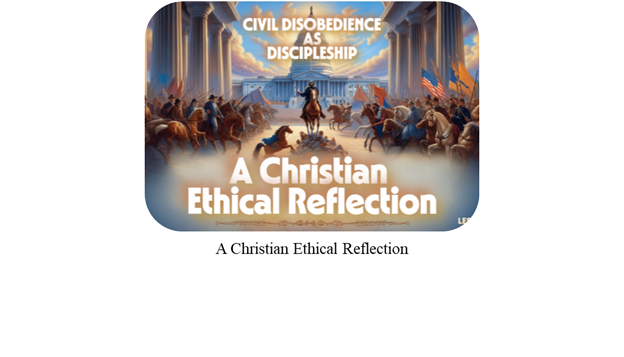
Civil Disobedience as Discipleship: A Christian Ethical Reflection
The question of civil disobedience has long pressed upon the Christian conscience, raising the tension between honoring civil authorities and remaining faithful to God’s higher moral law. Scripture affirms that government is ordained by God (Romans 13:1-7, King James Version), yet it also reminds believers that human authority is not absolute. When obedience to civil law collides with obedience to divine command, the Christian must discern where ultimate allegiance lies.
Bostron (2025) frames this dilemma not in terms of rebellion but in terms of discipleship. He writes: “For me, civil disobedience is not about defiance; it is about discipleship. It is about bearing witness to the higher law of God with peace, conviction, and a willingness to accept the cost of obedience” (Bostron, 2025).
This perspective emphasizes that, when necessary, civil disobedience is not an act of hostility toward government but a testimony of faithfulness to Christ. It is a spiritual discipline rooted in prayer, humility, and obedience, rather than in anger or defiance.
Norman Geisler (2010) provides a helpful ethical framework that complements this conviction. He argues that while God ordains government, its authority is limited. When human laws require disobedience to God’s higher moral law, resistance may be justified. However, Geisler insists that such resistance must remain:
Nonviolent – never seeking to harm, but to bear witness.
Conscientious – grounded in conviction, not personal preference.
Willing to accept consequences – even legal penalties, which strengthen the credibility of the testimony.
Taken together, Bostron’s reflection and Geisler’s framework highlight the same essential truth: Christian civil disobedience must be carried out with humility, courage, and a willingness to endure suffering in obedience to God. The credibility of the Christian witness is not found in the loudness of protest but in the quiet strength of faithfulness, even when it costs dearly.
Scripture provides the compass for this conviction. The apostles declared, “We ought to obey God rather than men” (Acts 5:29, KJV), a verse that has guided countless believers in times of conflict between divine and human authority. This passage does not encourage reckless defiance but calls for steadfast obedience to God when human commands contradict His will.
The church, therefore, bears a responsibility not only to speak truth to power but also to prepare its members for the sacrifices that may accompany faithful obedience. This preparation involves spiritual formation through prayer and humility, practical readiness to endure consequences with grace, and communal support so that no believer stands alone in the struggle. In this way, civil disobedience becomes not merely a political act but a spiritual testimony—an embodied witness to the higher law of God.
In today’s context, this call to civil disobedience as discipleship intersects with pressing ethical challenges, including religious liberty in the workplace, conscience-based objections in healthcare, and the church’s response to systemic injustice. Believers may face situations in which compliance with civil mandates conflicts with their biblical convictions—whether by refusing to participate in practices that violate the sanctity of life, resisting policies that compromise religious expression, or standing against laws that perpetuate inequality. In each case, the framework articulated by Bostron (2025) and Geisler (2010) provides a guide: resistance must remain peaceful, conscientious, and willing to accept consequences. By embodying this ethic, Christians demonstrate that their ultimate allegiance is not to cultural trends or political expediency but to the higher law of God. Such a witness not only preserves the integrity of personal faith but also challenges the broader society to reckon with the moral and spiritual dimensions of justice.
Peace and Grace,
Lesallan
References:
Bostron, L. (2025, October 25). A Christian perspective on civil disobedience – A journey in life. The Christian Thing. https://thechristianthing.com/a-christian-perspective-on-civil-disobedience/
Geisler, N. L. (2010). Christian ethics: Contemporary issues & options (2nd ed.). Baker Academic.