Lesallan | April 23, 2026
Balancing Tasks and Relationships: A Contingency Approach to Leadership
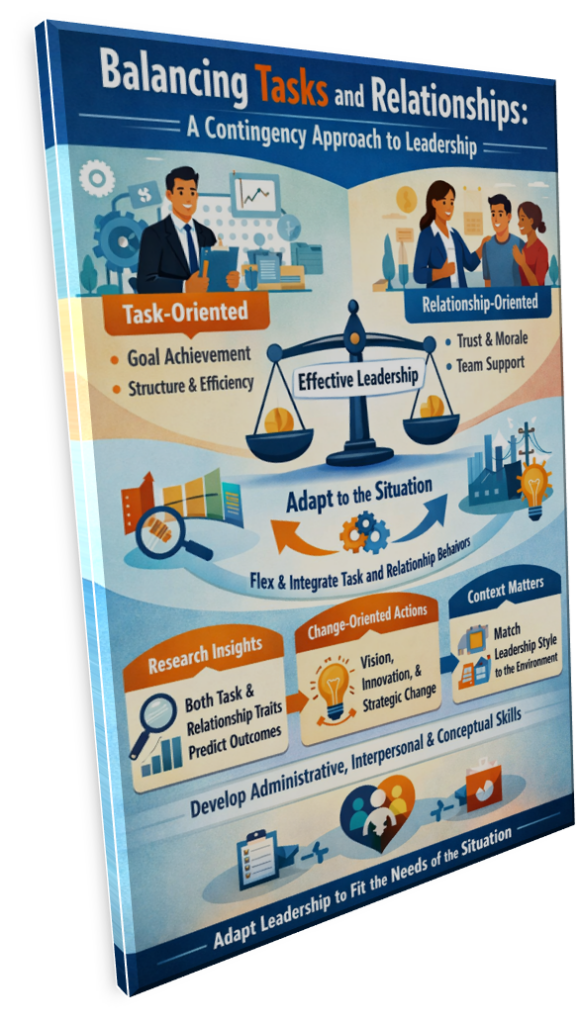
Leaders must continually balance getting work done with maintaining healthy relationships among team members; this balance is central to effective leadership and is emphasized in this week’s course text (Matkin et al., 2023). The text frames leadership as a dynamic interplay among administrative, interpersonal, and conceptual skills, and it highlights how task‑oriented and relationship‑oriented styles each contribute to organizational functioning. Task‑oriented leaders prioritize structure, role clarity, and goal attainment, which helps teams meet deadlines and maintain consistent performance. Relationship‑oriented leaders prioritize trust, morale, and interpersonal support, which fosters engagement, retention, and long‑term collaboration. Matkin and colleagues (2023) underscore that both orientations are valuable and that leaders must develop the administrative and interpersonal competencies to apply the appropriate emphasis as situations demand.
Empirical research supports the textbook’s contention that task and relationship behaviors are both positively associated with desirable outcomes, but their relative impact depends on context and outcome measures. Judge and Piccolo’s (2004) meta‑analytic review found that leader behaviors related to initiating structure (task focus) and consideration (relationship focus) are both linked to follower performance and satisfaction, with differences in effect sizes across outcome types. More recent work by Yukl and colleagues (2019) extends this view by distinguishing broad categories of leader behavior—task, relations, and change‑oriented—and showing that each category uniquely predicts aspects of managerial effectiveness. Yukl et al. (2019) emphasize that problem‑solving and clarifying roles (task behaviors) strongly predict objective performance indicators, whereas recognition and support (relations behaviors) are more closely tied to subordinate satisfaction and commitment.
The idea that task‑ and relationship‑oriented behaviors lie along a continuum is useful because it captures the flexibility leaders need in practice. Rather than treating style as a fixed trait, contingency perspectives and the empirical literature suggest that effective leaders diagnose situational demands and shift their emphasis accordingly (Judge & Piccolo, 2004; Yukl et al., 2019). Change‑oriented behaviors—such as articulating a compelling vision, communicating the rationale for change, and mobilizing stakeholders—functionally bridge the task–relationship continuum: they require conceptual framing and strategic direction (task elements) while simultaneously relying on influence, empathy, and trust building (relationship elements). During periods of organizational change, leaders who integrate change‑oriented actions with both task clarity and relational support are better able to align people and processes toward new goals.
Personally, I view context as the decisive factor in choosing whether task or relationship leadership should predominate. In high‑pressure, time‑sensitive, or highly structured operational settings, task leadership is essential to ensure safety, quality, and timeliness. In service, creative, or developmental settings where innovation and retention matter, relationship leadership becomes more important. However, this is not an either/or choice; the most effective leaders cultivate administrative, interpersonal, and conceptual skills so they can flex along the continuum as circumstances change (Matkin et al., 2023; Yukl et al., 2019). Practically, this means developing routines and tools for clarifying roles and expectations while also investing in practices that build trust and psychological safety.
In closing, the course text and peer‑reviewed research converge on a pragmatic prescription: leaders should build a repertoire of specific task, relational, and change‑oriented behaviors and apply them contingently. For discussion, I welcome peers who emphasize a different weighting of task versus relationship leadership to share examples from their work contexts; contrasting cases (e.g., emergency operations versus long‑term program development) will help illustrate when each emphasis is most effective. I also invite peers who agree with this contingency view to add evidence or practical techniques for developing the three core skill sets (administrative, interpersonal, conceptual) described by Matkin et al. (2023).
~Lesallan
References:
Judge, T. A., & Piccolo, R. F. (2004). Transformational and transactional leadership: A meta‑analytic test of their relative validity. Journal of Applied Psychology, 89(5), 755–768. https://doi.org/10.1037/0021-9010.89.5.755
Matkin, G. S., et al. (2023). Developing human potential (Chapters: Developing Human Potential; Diversity & Inclusion; Leadership & Civic Engagement: Becoming the Change Maker). University of Nebraska Pressbooks. https://doi.org/10.32873/unl.dc.oth.015
Yukl, G., Mahsud, R., Prussia, G., & Hassan, S. (2019). Effectiveness of broad and specific leadership behaviors. Personnel Review, 48(3), 774–783. https://doi.org/10.1108/PR-03-2018-0100




2 Comments
score808 · April 23, 2026 at 5:04 pm
Keep educating and inspiring others with posts like this.
symptoms explain · April 24, 2026 at 6:48 am
Thanks for sharing this useful information.
Comments are closed.