Lesallan | September 21, 2025
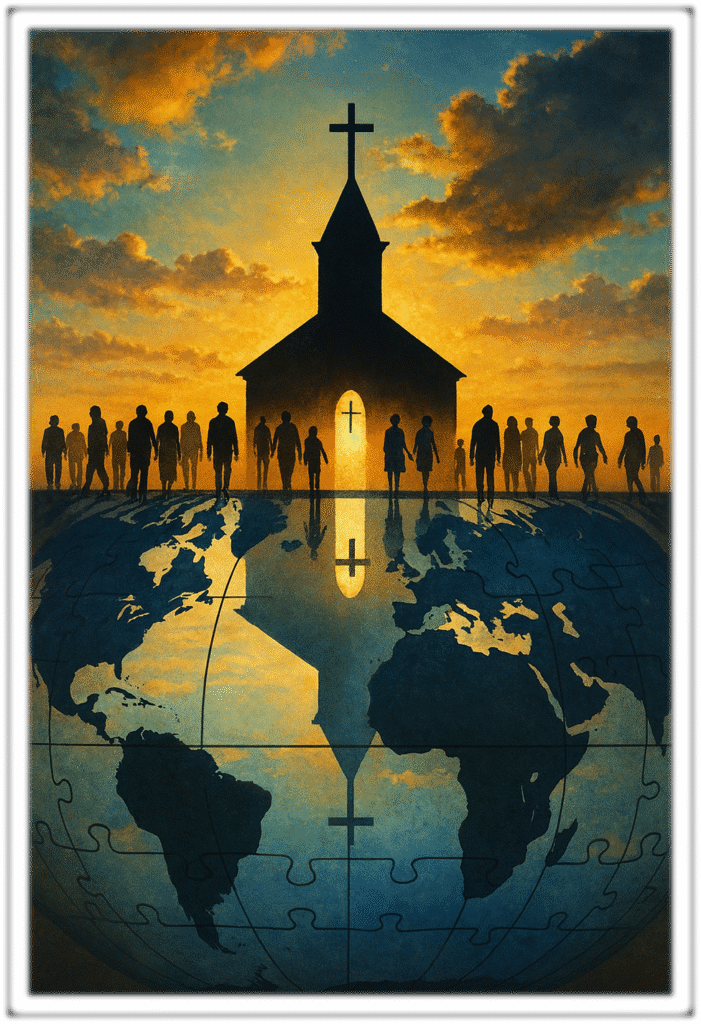
Globalization, Immigration, and the Call to a Deeper Church
In a recent discussion, one student offered a compelling reflection on how globalization and shifting immigration patterns are reshaping the American church. Her words reminded me that we are living in a moment of both challenging and extraordinary opportunity.
She rightly points out that multicultural worship services and outreach programs are not just creative ministry ideas—they are glimpses of the biblical vision in Revelation 7:9, where “a great multitude…from every nation, tribe, people and language” stands before the throne of God (New International Version, 2011). When churches intentionally create spaces where immigrants can worship in their own languages, sing their own songs, and bring their own traditions, they are not diluting the gospel—they are displaying it in full color.
Yet she also names a hard truth: too often, diversity is celebrated at the surface level while leadership structures remain unchanged. Immigrant believers may be welcomed into the pews but not into the pulpit, the boardroom, or the planning table. This is not simply a missed opportunity—it is a theological contradiction. As Jenkins (2011) observes, the global church is growing most rapidly in the Global South, and the vitality of these communities offers wisdom and leadership the American church desperately needs.
The early church faced a similar challenge. In Acts 10, Peter’s encounter with Cornelius shattered his cultural assumptions and expanded his understanding of God’s mission. The Spirit was already at work in Cornelius’s household before Peter arrived—Peter’s role was to recognize, affirm, and join in. Likewise, our role today is not to “grant” leadership to immigrant believers as if it were ours to give, but to recognize the Spirit’s gifting and authority already present in them.
Her commitment to cultural sensitivity and intentional relationship-building is exactly the posture we need. But it also raises a practical question for all of us in ministry: How can our churches assess and reshape their leadership pipelines so that immigrant voices are not only heard but trusted, commissioned, and celebrated?
The answer will look different in every context, but the principle is the same: Galatians 3:28 reminds us that “there is neither Jew nor Greek…for you are all one in Christ Jesus” (New International Version, 2011). This unity is not uniformity—it is the Spirit-breathed harmony of diverse voices leading together for the sake of the gospel.
May we see immigration not as a disruption to church life, but as a divine appointment—an opportunity to embody the kingdom vision here and now.
Blessings,
Lesallan
References:
Jenkins, P. (2011). The next Christendom: The coming of global Christianity (3rd ed.).
Oxford University Press.
New International Version Bible. (2011). Biblica.