Written by Lesallan | September 30, 2025
Listening to the King
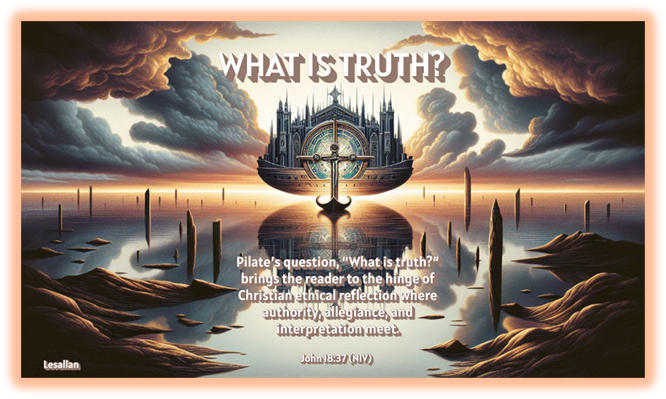
Pilate’s question, “What is truth?” brings the reader to the hinge of Christian ethical reflection where authority, allegiance, and interpretation meet. Jesus’ claim that “Everyone on the side of truth listens to me” reframes truth as personal and relational rather than merely propositional or procedural (John 18:37, New International Version). This devotion examines how disagreements about ethical truth often arise from differing sources of authority or from divergent applications of a shared authority, proposes practices for charitable reasoning, and will answer the reflective questions posed in the original devotional instruction.
Conflicts over ethics commonly stem from two sources. First, people disagree about where truth is found. Those who look to Jesus and the biblical witness as primary authority interpret ethical questions through scripture, tradition, reason, and experience, considering Christ’s person and teaching. Those who privilege other authorities—such as secular philosophy, cultural norms, or pragmatic outcomes—will inevitably reach different moral judgments. Second, even when the same authority is accepted, believers may differ in how they interpret and apply scriptural texts to complex cases. Careful reading, historical awareness, and theological prudence can yield divergent, yet sincere, conclusions about issues such as obedience to civil authority or the legitimacy of civil disobedience (John 18:37-38, New International Version).
Listening to Jesus entails both devotion and discernment. Discipleship requires the formation of habits that integrate heart and mind: prayerful study, engagement with diverse interpretations, and disciplined argumentation. One foundational practice of critical thinking is the charitable reconstruction of opposing positions: to explain a theory so clearly that a proponent would affirm the summary. This practice neither requires abandoning one’s convictions nor permits intellectual dishonesty; rather, it prepares believers for persuasive, humble dialogue and for ethical reasoning that seeks truth rather than merely victory. Jesus’ manner before Pilate models a posture of witness rather than rhetorical domination; he testifies to a truth embodied in his life and mission (John 18:37, New International Version).
Ethical engagement requires careful attention to the sources of authority that shape judgment, whether scripture, tradition, reason, or experience, with clarity about which carries decisive weight and why. It also calls for charitable comprehension, ensuring that opposing views are summarized in a way that their advocates would recognize themselves in the representation before critique is offered. In this process, one must distinguish between core convictions that remain non-negotiable and prudential judgments that may be revised considering stronger arguments or new evidence. Allegiance is not only professed but rehearsed in daily choices, as truth is revealed in the small, repeated decisions where loyalties are formed and lived out (John 18:37, NIV).
I am comfortable with the concept that truth is fundamentally relational and centered in the person of Christ. Understanding truth as personal reorients ethics from rule compliance to formation in Christlike character and practice, which coheres with Jesus’ claim that those on the side of truth listen to him (John 18:37, New International Version).
It is disconcerting that devoted, integrity-filled Christians can arrive at different ethical conclusions after prayerful, careful study. The reality of such disagreement challenges a longing for unanimity and can feel destabilizing. Nevertheless, that discomfort can be a catalyst for humility, rigorous reasoning, and patient community, provided disagreements are navigated with charity and a shared commitment to following Christ (John 18:37-38, New International Version).
Lord Jesus, you are the truth who stands before power and promises life to those who listen. Grant us ears to hear your voice, minds to understand difficult arguments, and hearts humble enough to be corrected. Help us to live by the truth you embody and to pursue ethical clarity with charity and courage. Amen.
Peace and Grace,
Lesallan