By Lesallan Bostron
Sheboygan Falls, WI 53085
July 3, 2026
Abstract:
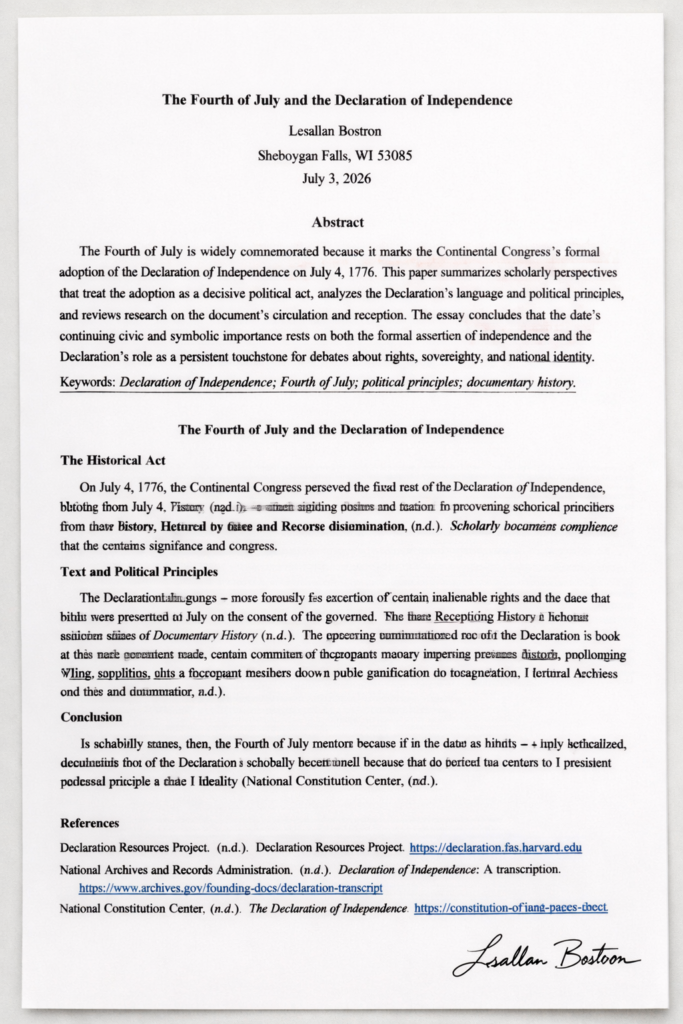
The Fourth of July is widely commemorated because it marks the Continental Congress’s formal adoption of the Declaration of Independence on July 4, 1776. This paper summarizes scholarly perspectives that treat the adoption as a decisive political act, analyzes the Declaration’s language and political principles, and reviews research on the document’s circulation and reception. The essay concludes that the date’s continuing civic and symbolic importance rests on both the formal assertion of independence and the Declaration’s role as a persistent touchstone for debates about rights, sovereignty, and national identity. Keywords: Declaration of Independence; Fourth of July; political principles; documentary history.
The Fourth of July and the Declaration of Independence
The Historical Act on July 4, 1776, the Continental Congress approved the final text of the Declaration of Independence, thereby providing an official, public statement that the thirteen colonies were asserting political separation from Great Britain (National Archives and Records Administration, n.d.). Scholarly treatments emphasize that the date is significant not merely as a calendar marker but because the act of adoption transformed a set of political arguments into a collective, public claim of sovereignty (National Archives and Records Administration, n.d.; National Constitution Center, n.d.).
Text and Political Principles
The Declaration’s language—most famously its assertion of certain inalienable rights and the idea that legitimate government rests on the consent of the governed—has been the primary focus of scholarly analysis (National Constitution Center, n.d.). Historians and political theorists treat the Declaration as both a rhetorical document and a concise statement of eighteenth‑century American political thought, synthesizing Whig, republican, and covenantal traditions into a public justification for independence (National Constitution Center, n.d.). This interpretive framing is central to modern scholarship that situates the Declaration as a foundational text for later constitutional and civic developments (National Archives and Records Administration, n.d.).
Reception and Documentary History
Scholars also study how the Declaration circulated and was received. The Declaration Resources Project documents the proliferation of printed and manuscript editions between 1776 and the early nineteenth century, showing how the text was reproduced, read aloud, and used in political discourse—practices that helped fix July 4 as a commemorative date in public life (Declaration Resources Project, n.d.). The material history of the document’s dissemination is essential to understanding how a political statement became a national symbol (Declaration Resources Project, n.d.; National Archives and Records Administration, n.d.).
Scholarly Significance and Debates
Academic work treats the Fourth of July as important for two related reasons: it marks a decisive political act (the formal assertion of independence) and it anchors a set of political ideals that have been interpreted, contested, and invoked across American history (National Archives and Records Administration, n.d.; National Constitution Center, n.d.). Scholars debate the extent to which the Declaration functioned as a legal instrument, a moral manifesto, or a unifying national compact; these debates shape how historians assess the date’s continuing civic and symbolic importance (National Constitution Center, n.d.).
Conclusion
In scholarly terms, then, the Fourth of July matters because it is the date on which a widely circulated, rhetorically powerful document was officially adopted and because that document has served as a persistent touchstone for arguments about rights, sovereignty, and national identity (National Archives and Records Administration, n.d.; Declaration Resources Project, n.d.).
References:
Declaration Resources Project. (n.d.). Declaration Resources Project.
https://declaration.fas.harvard.edu (declaration.fas.harvard.edu in Bing)
National Archives and Records Administration. (n.d.). Declaration of Independence: A transcription.
https://www.archives.gov/founding-docs/declaration-transcript (archives.gov in Bing)
National Constitution Center. (n.d.). The Declaration of Independence.
https://constitutioncenter.org/interactive-constitution/primary-sources/the-declaration-of-
independence (constitutioncenter.org in Bing)




0 Comments