Lesallan Bostron
University of Arkansas – Grantham
Dr. D. McNamee
April 10, 2026
From Technical Skill to Team Impact: The Case for Leadership Education
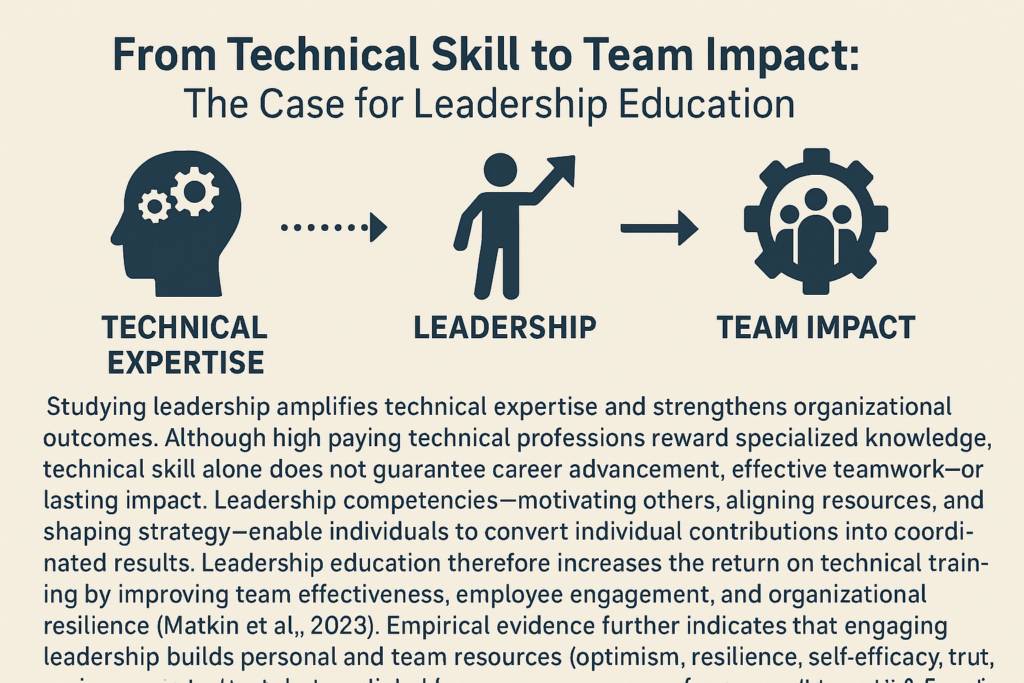
Studying leadership amplifies technical expertise and strengthens organizational outcomes. Although high‑paying technical professions reward specialized knowledge, technical skill alone does not guarantee career advancement, effective teamwork, or lasting impact. Leadership competencies—motivating others, aligning resources, and shaping strategy—enable individuals to convert individual contributions into coordinated results. Leadership education therefore increases the return on technical training by improving team effectiveness, employee engagement, and organizational resilience (Matkin et al., 2023). Empirical evidence further indicates that engaging leadership builds personal and team resources (optimism, resilience, self‑efficacy, trust, and communication) that mediate higher engagement and performance (Mazzetti & Schaufeli, 2022).
For graduates who lack enthusiasm for their major, leadership development offers a practical route to meaningful work and influence. Passionate leadership depends less on a degree title and more on curiosity about people, commitment to continuous learning, and deliberate practice of core leadership behaviors such as visioning, ethical decision making, and interpersonal influence (Matkin et al., 2023). Students can cultivate leadership through attainable steps: pursue cross‑functional experiences (internships, volunteer roles, project teams), enroll in short leadership courses or certificate programs, and seek mentors who broaden career perspectives. These activities develop transferable competencies—communication, conflict resolution, and strategic thinking—that enable graduates to create impact regardless of their major. Over time, focusing on tangible effects (improving processes, mentoring colleagues, solving meaningful problems) often reveals intrinsic motivation and converts ambivalence into authentic leadership (Matkin et al., 2023).
Emotional expression by leaders requires careful calibration because authenticity and self‑regulation both sustain trust. Contemporary leadership theory emphasizes emotional intelligence—awareness, regulation, and appropriate expression of emotion—as a core competency (Brighton School of Business and Management, 2014). Measured vulnerability (for example, admitting uncertainty or expressing grief) can humanize leaders and deepen follower commitment when contextually appropriate and followed by constructive action. Conversely, ranting, sustained swearing, or explosive outbursts are counterproductive: they erode trust, reduce cohesion, and impair performance (J5R Business Services, 2014). Acceptable emotional expression therefore depends on intent, proportionality, and aftermath; effective leaders acknowledge feelings, restore composure, and translate emotion into clear next steps that support the team’s needs (Matkin et al., 2023).
Integrating leadership education with technical training yields practical benefits for individuals and organizations. Technically trained leaders bridge strategy and execution, improving decision quality and implementation speed. Leadership skills increase employability and career mobility by preparing professionals to lead projects, manage teams, and influence stakeholders—roles that often carry broader impact and higher compensation. Organizations that invest in leadership development report higher engagement and better team outcomes because leaders create environments that foster psychological safety and continuous improvement (Mazzetti & Schaufeli, 2022; Matkin et al., 2023). Embedding experiential leadership opportunities, mentorship, and emotional‑intelligence training into technical programs ensures graduates are not only competent but also prepared to mobilize others toward shared goals.
In sum, leadership education multiplies the value of technical training by turning individual expertise into coordinated, sustainable impact: it equips practitioners to motivate teams, align resources, and translate strategy into results. By building emotional intelligence, communication, and practical leadership habits—through cross‑functional experiences, mentorship, and targeted coursework—graduates gain the tools to increase team effectiveness, career mobility, and organizational resilience. For students who feel disconnected from their major, leadership development offers a concrete pathway to meaningful work and influence that depends on practice more than pedigree. Embedding experiential leadership opportunities alongside technical curricula ensures that tomorrow’s professionals are not only technically competent but also prepared to mobilize others toward shared goals and lasting improvement.
References:
Brighton School of Business and Management. (2014, July 10). Core leadership theories [Video]. YouTube. https://www.youtube.com/watch?v=SRrC67py-4E (youtube.com in Bing)
J5R Business Services. (2014, April 24). 10 traits of great leaders [Video]. YouTube. https://www.youtube.com/watch?v=Tv6c6KCO36w (youtube.com in Bing)
Matkin, G. S., et al. (2023). Developing human potential: A personal approach to leadership. Open Textbook Library. https://open.umn.edu/opentextbooks/textbooks/1471 (open.umn.edu in Bing)
Mazzetti, G., & Schaufeli, W. B. (2022). The impact of engaging leadership on employee engagement and team effectiveness: A longitudinal, multi‑level study on the mediating role of personal‑ and team resources. PLoS ONE, 17(6), e0269433. https://doi.org/10.1371/journal.pone.0269433