Lesallan | 07/13/2025
Written by Lesallan | July 13, 2025
Is Humanity Living on a Rock or Sand Formation?
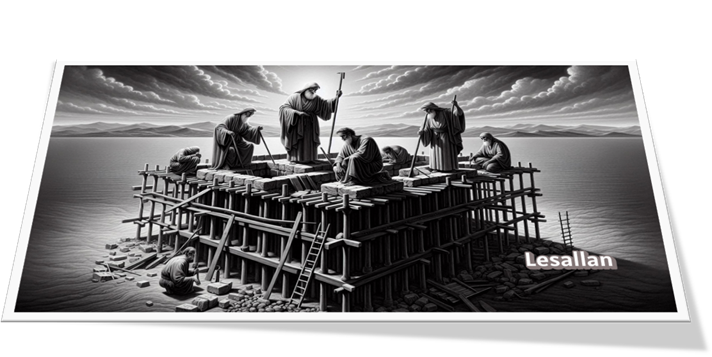
The parable of the wise and foolish builders in Matthew 7:24-29 (KJV) presents a powerful metaphor for the foundations upon which individuals and societies construct their lives. When Jesus states, “Whosoever heareth these sayings of mine, and doeth them, I will liken him unto a wise man, which built his house upon a rock,” he highlights the enduring strength that comes from hearing and applying his teachings (Matthew 7:24-25, King James Version). Conversely, building on sand—“and every one that heareth these sayings of mine, and doeth them not, shall be likened unto a foolish man, which built his house upon the sand”—illustrates the fragility of a life lacking solid guiding principles (Matthew 7:26–27, King James Version).
Building on a rock symbolizes stability, resilience, and wisdom. The “rain descended, and the floods came, and the winds blew, and beat upon that house; and it fell not” because its foundation on the rock absorbed and dispersed the forces against it (Matthew 7:25, King James Version). For humanity, a rock-like foundation can be understood as a commitment to enduring values—such as compassion, integrity, and truth—that withstand societal pressures and existential challenges. These values serve as bedrock, ensuring that individuals and communities remain stable even when faced with challenges.
In contrast, sand represents superficiality, impulsiveness, and negligence. When the foolish man’s house built on sand faces the same storm, it collapses, and “great was the fall of it” (Matthew 7:27, King James Version). Societies built on shifting ideologies—such as unchecked materialism, intolerance, or moral relativism—risk disintegration when confronted with crises. Without a firm moral compass, decisions become reactive, short-sighted, and vulnerable to the first gust of adversity.
Humanity today stands at a crossroads: to persist in a shifting landscape of transient trends and self-centered pursuits, or to anchor itself in the rock of timeless principles and purposeful living. In an era marked by rapid change and uncertainty, the choice between these two foundations has never been more consequential. Embracing the “sayings” that lead to wise construction calls for intentional reflection, community engagement, and consistent practice of values that transcend cultural and temporal boundaries.
The challenge for each person—and humanity collectively—is to examine the foundations of our beliefs and actions. By choosing to build on the rock of enduring truths, we not only safeguard against life’s inevitable storms but also cultivate communities capable of flourishing in the face of adversity. Let us heed the call to wise building, ensuring that our individual and collective houses stand firm for generations to come.
Many Blessings,
Lesallan
References:
King James Bible Online. (1769). Matthew 7:24-29. Retrieved from
https://www.kingjamesbibleonline.org/Matthew-7-24_7-29
For further contact:
lesbostron@outlook.com
thechristianthingtodo@gmail.com
lbostron@ohiochristian.edu