By Lesallan
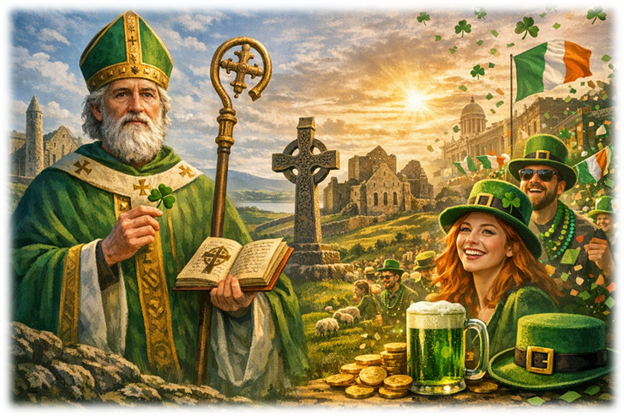
Saint Patrick’s Day: Missionary Legacy, Myth, and Modern Meaning
Saint Patrick’s Day commemorates a historical missionary—Saint Patrick—whose fifth‑century ministry helped anchor Christianity in Ireland; today the holiday blends that religious legacy with centuries of legend and modern cultural celebration (observed worldwide on March 17; note: today is March 18, 2026, in Sheboygan Falls, WI).
Introduction
Saint Patrick’s Day is commonly thought of as a festive, green‑clad celebration of Irish identity, but its origins lie in the memory of a Christian missionary credited with significant evangelizing work in Ireland. Understanding what the day is “really about” requires separating Patrick’s historical role from later hagiography and modern secularization.
Historical background and primary evidence
The best historical window into Patrick himself comes from two short works attributed to him (the Confessio and the Letter to the Soldiers of Coroticus), which present Patrick as a Romano‑British Christian who was enslaved in Ireland, escaped, and later returned as a missionary. Scholars emphasize that while Patrick was pivotal, Christianity had multiple entry points into Ireland and Patrick’s writings are as much moral testimony as straightforward biography.
Legend versus documented ministry
Over the centuries, legends (banishing snakes, using the shamrock to teach the Trinity) accrued around Patrick and became central to popular memory. Modern historians treat many of these motifs as symbolic or later accretions rather than literal events. The scholarly consensus is that Patrick’s importance rests on his surviving writings and the later cult that formed around him, not on miraculous episodes found only in later hagiography.
Religious significance
For Christians—especially in Ireland and among the Irish diaspora—Saint Patrick’s Day is first and foremost a feast commemorating a missionary who helped institutionalize Christian practice on the island. Liturgically and devotionally, the day honors Patrick’s witness, his pastoral letters, and his example of evangelistic commitment. Contemporary Christian commentators also use the day to reflect on evangelism, discipleship, and social concerns Patrick addressed in his writings.
Contemporary observance and cultural layering
Today, the feast combines religious observance (church services, prayers) with secular and ethnic celebration (parades, music, food, and commercialized symbols). This dual character—sacred commemoration plus popular festivity—explains why St. Patrick’s Day can mean different things to different communities while still tracing back to a historical Christian figure.
Conclusion
Saint Patrick’s Day is really about remembering a historical missionary whose life and writings contributed to the Christianization of Ireland, even as centuries of legend and modern cultural practices have broadened the day’s meaning. Recognizing both the historical Patrick and the layers of later tradition gives a fuller, more nuanced appreciation of March 17 as both a religious feast and a global cultural celebration.
References:
Bury, J. B. (1905). The life of St. Patrick and his place in history. Macmillan.
Flechner, R. (2019). Saint Patrick retold: The legend and history of Ireland’s patron saint. Princeton University Press.
Christianity Today. (2026). St. Patrick articles. Christianity Today.
