Lesallan – July 8, 2024
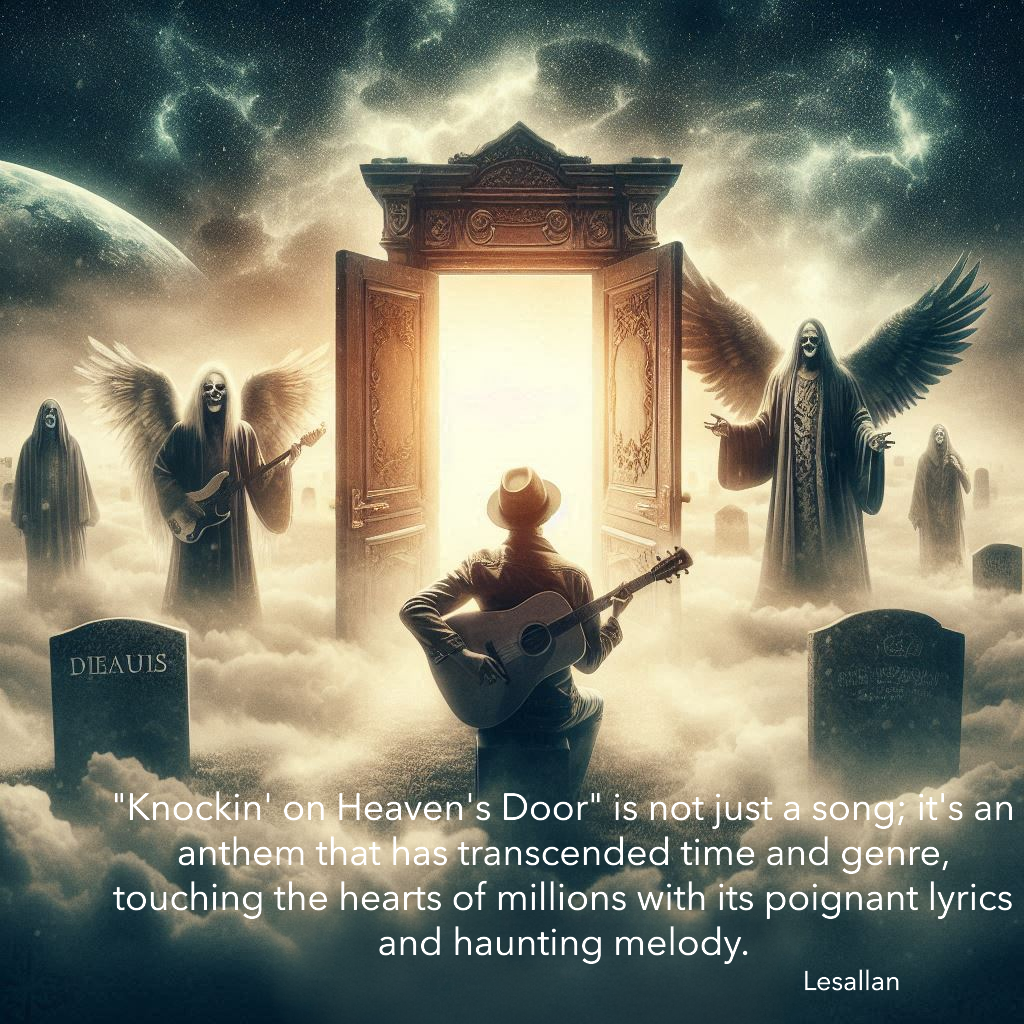
The Resonance of Knockin’ on Heaven’s Door: A Timeless Anthem
Lesallan – July 8, 2024
“Knockin’ on Heaven’s Door” has become more than just a song; it’s an anthem transcending time and genre, resonating with millions through its moving lyrics and haunting melody. Penned by Bob Dylan for the 1973 film “Pat Garrett and Billy the Kid,” the song profoundly reflects mortality and the universal passage toward the end of life.
The song’s straightforward lyrics and captivating melody have established it as a fundamental part of many artists’ repertoires across different music genres. From Bob Dylan’s folk origins to Guns N’ Roses’ complex rock renditions, the song’s adaptability proves its universal allure. The minimal lyrics invite interpretation, enabling listeners to discover their significance within the verses.
The song delves into the tale of a sheriff nearing the end of his life, contemplating his past and the inevitability of his mortality. It’s a reflective moment, a chance to pause amidst life’s turmoil and recognize the approaching transition. The recurring line, “It’s getting dark, too dark to see,” symbolizes the encroaching conclusion of one’s life journey and the embrace of destiny.
Over time, “Knockin’ on Heaven’s Door” has transcended its origins as a movie soundtrack and has become a cultural icon. The song has permeated our collective psyche with over 150 cover versions, each offering a unique interpretation. It is frequently played at funerals and memorials, serving as a powerful expression of sorrow and optimism.
The expression “knocking on heaven’s door” has become ingrained in our language, representing the boundary between life and the afterlife. This concept holds significance for everyone, regardless of their beliefs or upbringing. The song encapsulates the essence of our collective passage into the unfamiliar, making it a profound work of art that perpetually inspires and consoles.
In reflecting professionally on the song, it’s crucial to acknowledge the artistry involved in its creation. Dylan’s capability to express deep emotions through uncomplicated verses exemplifies his songwriting brilliance. The song’s structure, featuring a repetitive chorus and minimalist verses, evokes a feeling of universality. This format enables the listener to overlay their own experiences and emotions onto Dylan’s canvas.
As we contemplate the impact of “Knockin’ on Heaven’s Door,” it is evident that its legacy is firmly established in the annals of music history. The song resonates with the human experience, touching on moments of transition and introspection that are universal. Whether viewed through a spiritual, existential, or simply as a meditation on life’s journey, the song serves as a powerful reminder of our interconnected humanity and the artistic expressions that stem from it.
In summary, “Knockin’ on Heaven’s Door” transcends being just a song—it stands as a cultural relic that continues to resonate with successive generations. Its message of embracing and seeking peace remains as pertinent today as when Dylan initially crafted the lyrics. As we listen to the familiar melodies and join in with the timeless refrain, we are prompted to recognize the potency of music to unite us, articulate the ineffable, and offer comfort in the face of life’s ultimate transition.
Blessings,
Lesallan