Lesallan | August 7, 2025
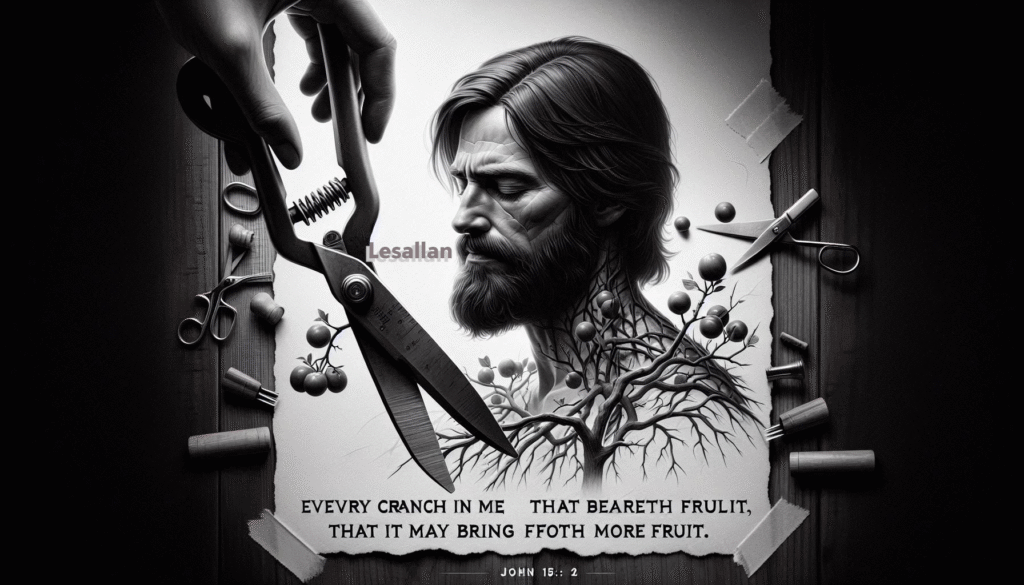
Through the Thorns: An honest acknowledgment of struggle in growth (The Vine, Part V)
Lesallan | August 7, 2025
We do not grow up in clean, quiet rooms. Growth happens where the shears flash and the skin remembers. Jesus names it plainly: “Every branch in me that beareth fruit, he purgeth it, that it may bring forth more fruit” (John 15:2, KJV). Pruning is not punishment; it is the painful mercy of a Father who refuses to let us settle for small fruit when abiding can yield more.
The paradox of holy pruning
To be “in Christ” is to be bound to his life, but also to his process. The very branches that are already bearing fruit are the ones the Vinedresser “purgeth” (John 15:2, KJV). We tend to equate pain with failure and flourishing with ease; Jesus overturns that instinct. The knife on living wood is not rejection—it’s preparation for deeper union: “Abide in me, and I in you… for without me ye can do nothing” (John 15:4-5, KJV).
Pruning clarifications. It shows where our energy is leaking into impressive leaves instead of nourishing hidden roots. It cuts back the good so the best has space to grow. The discomfort is not arbitrary; it is aimed at increasing love.
Thorns in the storyline of Scripture
Thorns are not a random image—they stretch through the whole biblical story. After the fall, the ground is marked by “thorns also and thistles” (Genesis 3:18, KJV), a sign that labor will now meet resistance. In Jesus’ parable, thorns choke the word—“the cares of this world, and the deceitfulness of riches, and the lusts of other things” strangling the life of the seed (Mark 4:7, 18–19, KJV). And at the cross, a crown of thorns is pressed upon the brow of the Vine Himself (John 19:2, KJV), the curse tangled into a sign of kingship—suffering transfigured into victory.
Sometimes thorns hedge our path: “Therefore, behold, I will hedge up thy way with thorns” (Hosea 2:6, KJV). Not every obstruction is the enemy; some are mercies that reroute us from lesser loves toward the One in whom our soul lives.
The vine and the thorn: When weakness becomes witness.
Paul calls his affliction a “thorn in the flesh” and pleads for its removal; the Lord answers with sufficiency, not subtraction: “My grace is sufficient for thee: for my strength is made perfect in weakness” (2 Corinthians 12:7-9, KJV). This is vine logic. The places we cannot manage, polish, or control become the very places where the life of Christ shows through.
Pruning and thorns both teach us to relinquish self-reliance. The first trims what is extra; the second humbles what is proud. Together they form a school of abiding—a way of staying with Jesus when disappointment, delay, or shame would drive us elsewhere (John 15:4–7, KJV).
Clean to the core: From purging to purity
John links pruning to cleansing. “Now ye are clean through the word which I have spoken unto you” (John 15:3, KJV). The same Father who “purgeth” the fruitful branch names the disciples already “clean” because of Jesus’ word. In other words, pruning is not a verdict on whether we belong; it is a vocation for those who already do. We are cut back not to be worthy, but because we are loved.
Scholars note that the verb behind “purgeth” in John 15:2 also carries the sense of “cleanses,” and John immediately pairs it with “ye are clean,” underscoring that the Word both forms and frees us. The knife and the word agree: God’s aim is fruit that lasts, born of a life that abides (Carson, 1991).
When pruning feels like loss
There are seasons when the shears seem relentless—friendships shift, platforms shrink, plans stall. We are tempted to measure our lives by outcomes we can count instead of fruit the Spirit grows. Scripture does not romanticize the pain: “No chastening for the present seemeth to be joyous, but grievous” (Hebrews 12:11a, KJV). Yet it also promises an afterward: “nevertheless afterward it yieldeth the peaceable fruit of righteousness unto them which are exercised thereby” (Hebrews 12:11b, KJV).
Loss can be holy if it clears the line between us and the Vine—if it loosens our grip on what cannot give life and steadies our hold on the One who does.
Abiding practices for thorny seasons
Bold confession and gentle consent. Name the thorn honestly before God—no pretending, no posturing—and then say, “Thy will be done” (Matthew 6:10, KJV). Confession tells the truth; consent trusts the Vinedresser.
Return to the Word that cleanses. Let Christ’s words abide in you—slow, repeated readings of John 15; praying the psalms; memorizing a single verse that meets your present pain (John 15:7, KJV).
Simplify to stay. Pruning simplifies. Ask: What leaf is sapping life right now—an overcommitment, a quiet resentment, an unguarded habit? Cut what keeps you from abiding (Hebrews 12:1, KJV).
Seek intercession, not isolation. Invite a trusted friend or mentor to pray specifically through this season’s thorn. Shared abiding strengthens weary branches (Galatians 6:2, KJV).
Look for the “afterward.” Keep a small record of graces—fresh patience, surprising gentleness, reordered desires. These are signs of fruit budding where the cut was made (Romans 5:3–5, KJV).
Hope at the heartwood.
The Father is no careless gardener. He handles the living places of our lives with wisdom and love. Jesus does not stand distant from our wounds; He wears a crown of thorns and calls us friends (John 19:2; 15:15, KJV). The Spirit does not abandon us in our weakness; He helps us pray when words run out (Romans 8:26, KJV).
If you feel the sting of the shears, you are not being cast off—you are being made room for. Through the thorns, the sap of Christ’s life still runs. Stay. Let His word hold you. The fruit will come in its time, and it will remain (John 15:16, KJV).
Blessings,
Lesallan
References:
Carson, D. A. (1991). The gospel according to John. Wm. B. Eerdmans Publishing Co.